Singalila National Park: Himalayan Wildlife Guide
The Sandakphu trek, red pandas and views of Kanchenjunga and Everest
About Singalila National Park
Singalila National Park stands on the Singalila Ridge in Darjeeling district, West Bengal, on the border with Sikkim and Nepal. It is a high-altitude Eastern Himalayan park of about 78.6 km², rising from roughly 2,300 m to around 4,000 m, and it holds the two highest peaks of West Bengal, Sandakphu at about 3,636 m and Phalut at about 3,600 m. It is a national park in its own right, not part of a tiger reserve, and it is best known for the ridge trail to Sandakphu.
The area was purchased by the British from Sikkim in 1882 and notified as a reserve forest. The botanist Joseph Dalton Hooker visited the ridge in 1849. It was declared a wildlife sanctuary in 1986 and became a national park in 1992. The 1905 attempt on Kanchenjunga also used the ridge as its approach, giving the trail a place in mountaineering history.
The range in elevation is what shapes the park. Subtropical pine forests in the lower valleys give way to broadleaf and mixed forest and then to subalpine conifers, with dense bamboo, oak, magnolia and rhododendron cloaking the slopes between 2,000 and 3,600 m. There are two seasons of bloom: rhododendrons flower in March and April, and the lower forests bloom with primulas, geraniums and orchids after the monsoon. Sandakphu is known as the "mountain of poisonous plants", for its Himalayan cobra lilies.
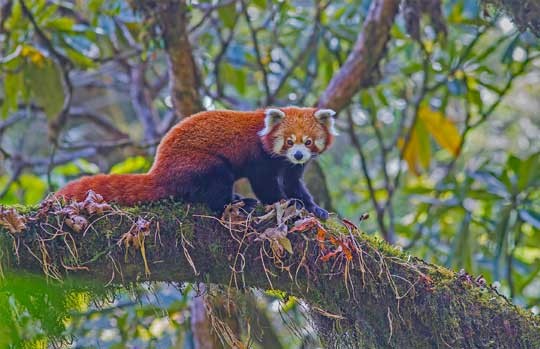
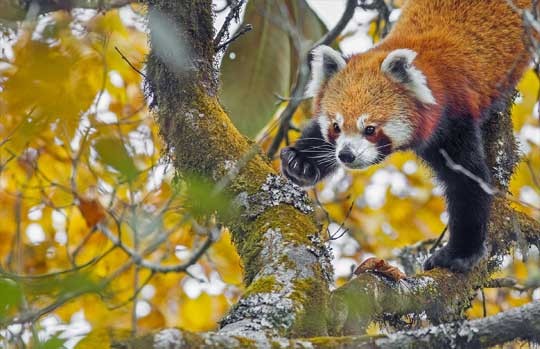
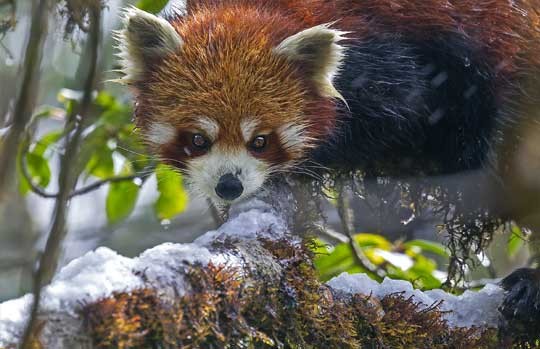
What makes Singalila distinctive is the combination of wildlife and views. It is one of the best places in India to look for the red panda, and the ridge gives clear views of Kanchenjunga, Everest, Lhotse and Makalu on a good morning. Himalayan black bear, serow, leopard and clouded leopard also live in the forests, and birders can look for pheasants and fire-tailed myzornis.
The park is also a living landscape. Small settlements such as Tumling and Kalipokhri sit along the trail, and trekkers' huts and homestays offer warm Himalayan hospitality.
What to expect: an on-foot or Land Rover journey along the ridge, with rhododendron forest, bamboo groves and open meadows, and evenings spent in simple mountain lodges. Wildlife is elusive and rewarding, and sightings, while never promised, are a special privilege.
Facts About Singalila National Park
| Information | Details |
|---|---|
| Location | Singalila Ridge, Darjeeling district, on the Sikkim and Nepal borders |
| State | West Bengal |
| Established | Wildlife sanctuary 1986; national park 1992 |
| Area | About 78.6 km² |
| Protected Area Type | National park |
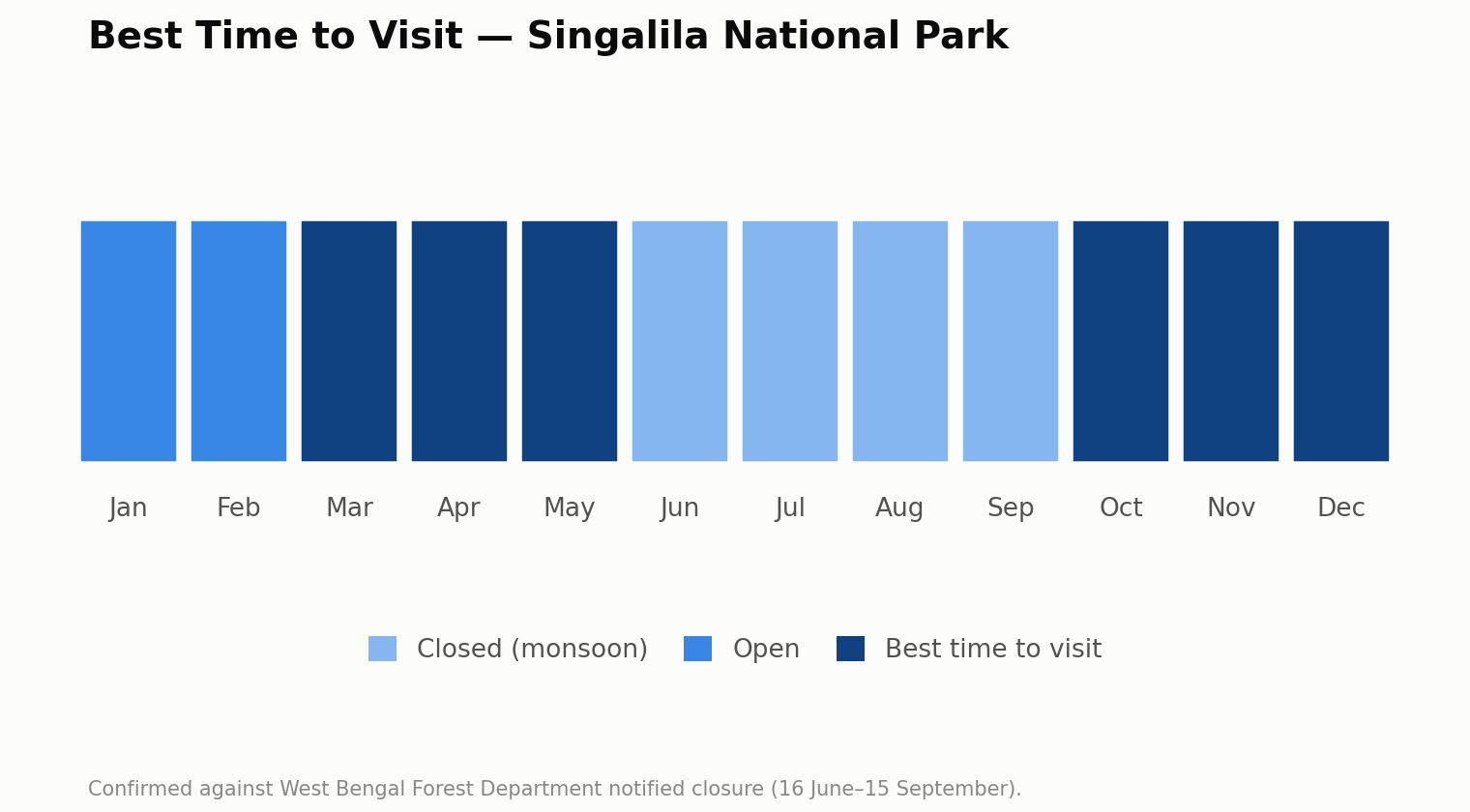
| Functional Days | Open to visitors from 16 September to 15 June |
| Annual Closure | Monsoon closure from 16 June to 15 September |
| Weekly Offs | None |
| Best Time to Visit | March to May and mid-September to early December |
| Recommended Safari Duration | Four to six days on the ridge, plus time in Darjeeling |
| Vegetation | Bamboo, oak, magnolia and rhododendron forest; subalpine conifer; alpine meadow |
| Elevation | About 2,300–4,000 m |
| Major Wildlife | Red panda, Himalayan black bear, leopard cat, barking deer, serow, clouded leopard |
| Famous For | The Sandakphu trek, red pandas and views of Kanchenjunga and Everest |
Functional days. The park welcomes visitors through the spring and post-monsoon seasons, with the trail busiest in October and again in April.
Yearly off. The park closes from mid-June to mid-September for the monsoon, when the ridge is wrapped in cloud and rain, and reopens as the skies clear.
Weekly offs and rules. There are no weekly closures. Visitors follow the ridge with a guide, carry out their rubbish and keep to the trail to protect slow-growing high-altitude plants.
Major Species
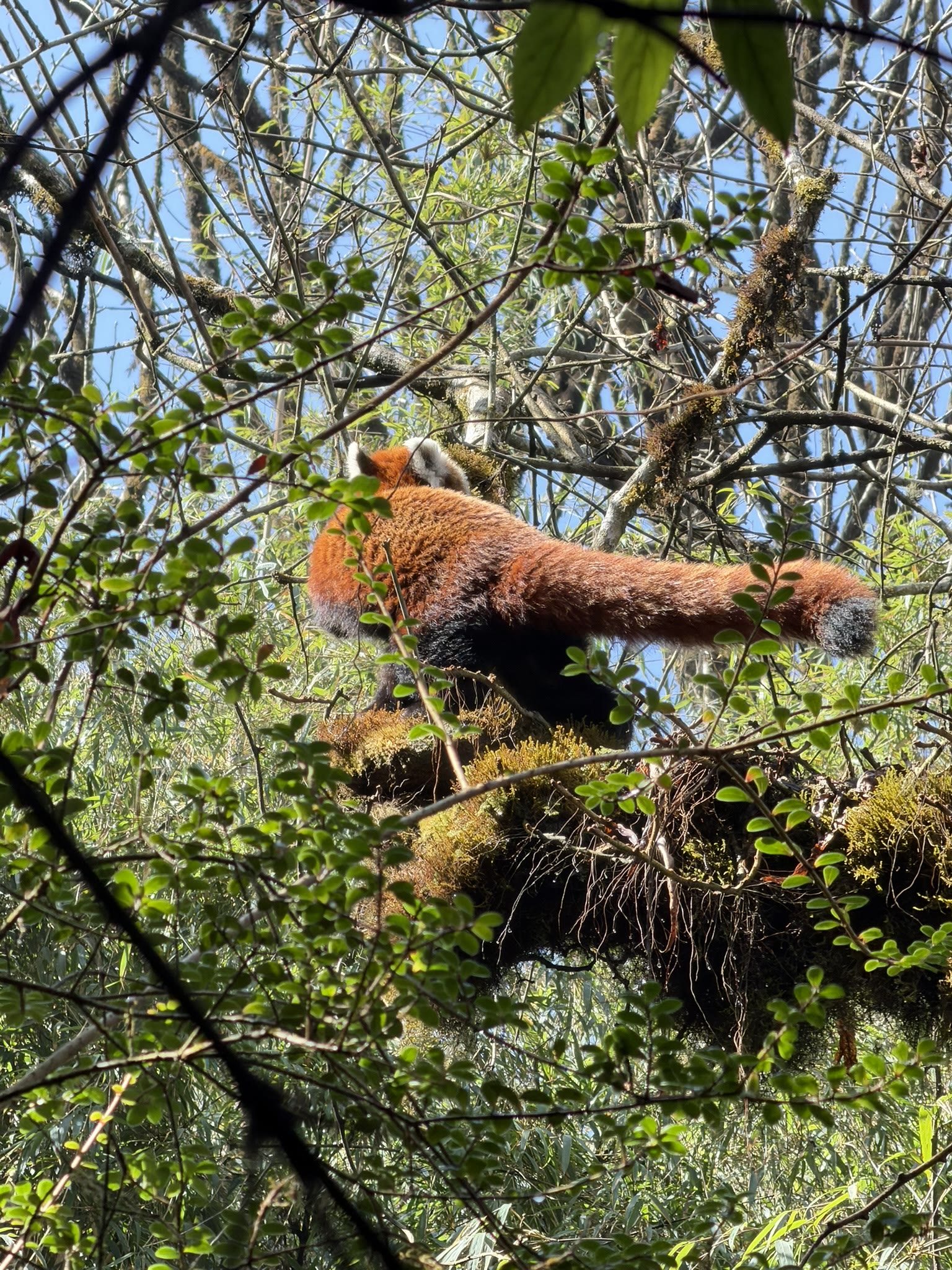
Singalila is not tiger country; its stars are the red panda and the mountain wildlife of the Eastern Himalaya. The park holds a resident red panda population, and it has been chosen for one of India's pioneering red panda reintroduction efforts.
| Year | Milestone | Detail |
|---|---|---|
| 2004 | Red panda reintroduction | Two captive-bred females from Darjeeling's Himalayan Zoological Park were released, and one adapted to the wild and gave birth to the first offspring |
| 2019 | Resident red pandas | About 42 |
The reintroduction was filmed in the documentary Cherub of the Mist, which won an international conservation film award. Red pandas are shy and arboreal, spending much of the day in bamboo and fir, so a sighting is a rare and special moment. Spring, when bamboo shoots and rhododendron blooms attract them, is a favoured time.
Other species
- Himalayan black bear: Present and seen occasionally on the lower slopes.
- Leopard and clouded leopard: Present and rarely seen.
- Serow and takin: Present in the higher forest, seen very occasionally.
- Barking deer, wild boar and yellow-throated marten: Seen from time to time along the trail.
- Leopard cat, pangolin and pika: Present and rarely seen.
- Birds: More than 120 species, including satyr tragopan, blood pheasant, kalij pheasant, Himalayan vulture and the fire-tailed myzornis.
Safari Zones in Singalila National Park
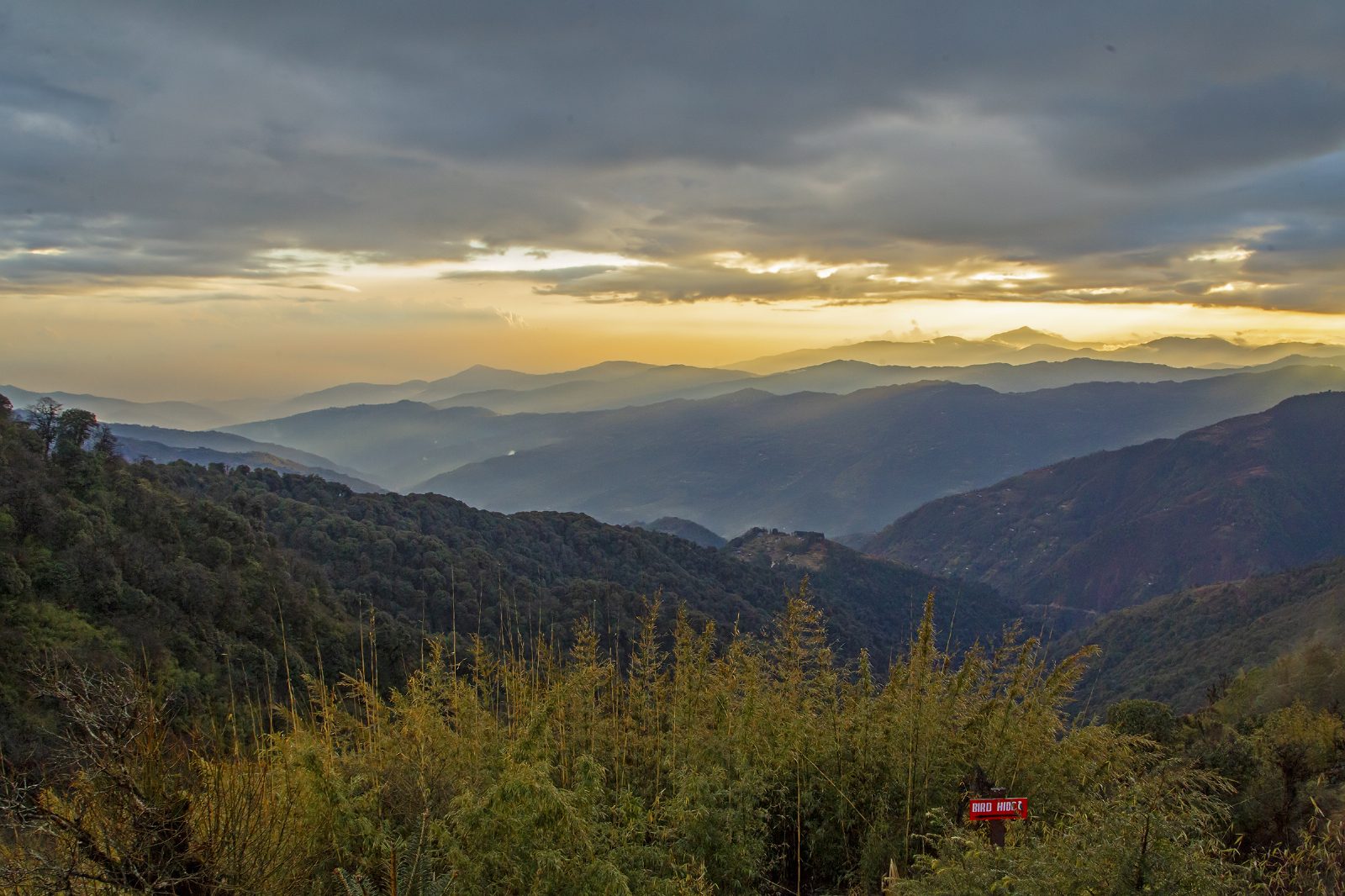
Singalila does not have vehicle safari zones. It is explored along the Singalila Ridge, by trek or by four-wheel-drive vehicle on the road to Sandakphu, with wildlife watched along the way. The classic route follows four stages from the gateway village of Manebhanjan.
| Stage | Elevation | Character |
|---|---|---|
| Manebhanjan to Meghma | About 2,600 m | A four-hour walk through lower forest |
| Meghma to Gairibans | About 2,621 m | Via Tonglu and Tumling, where the park boundary passes |
| Gairibans to Sandakphu | About 3,636 m | A steep climb of about four hours, passing Kalipokhri |
| Sandakphu to Phalut | About 3,600 m | The most pristine stretch, with wide views |
Manebhanjan to Meghma
The trail leaves Manebhanjan through lower forest of oak and bamboo, and Meghma sits above the mist at about 2,600 m. It is a gentle introduction, with birdsong and early views.
Meghma to Gairibans
Two routes lead to Gairibans, both passing Tonglu at about 3,070 m and Tumling at about 2,900 m, where the national park boundary and a checkpoint lie. The forest here is rich in rhododendron and bamboo, the habitat of red pandas.
Gairibans to Sandakphu
A steep climb of about four hours leads to Sandakphu, the highest point in West Bengal, passing the village of Kalipokhri at about 3,186 m beside a small lake. On clear mornings the summit gives wide views of Kanchenjunga and Everest.
Sandakphu to Phalut
The most pristine stretch of the ridge runs to Phalut, a day's walk of about 21 km via Sabarkum, with open meadows and sweeping views. Water is scarce on this section, so guides plan carefully.
Descents and Land Rover access
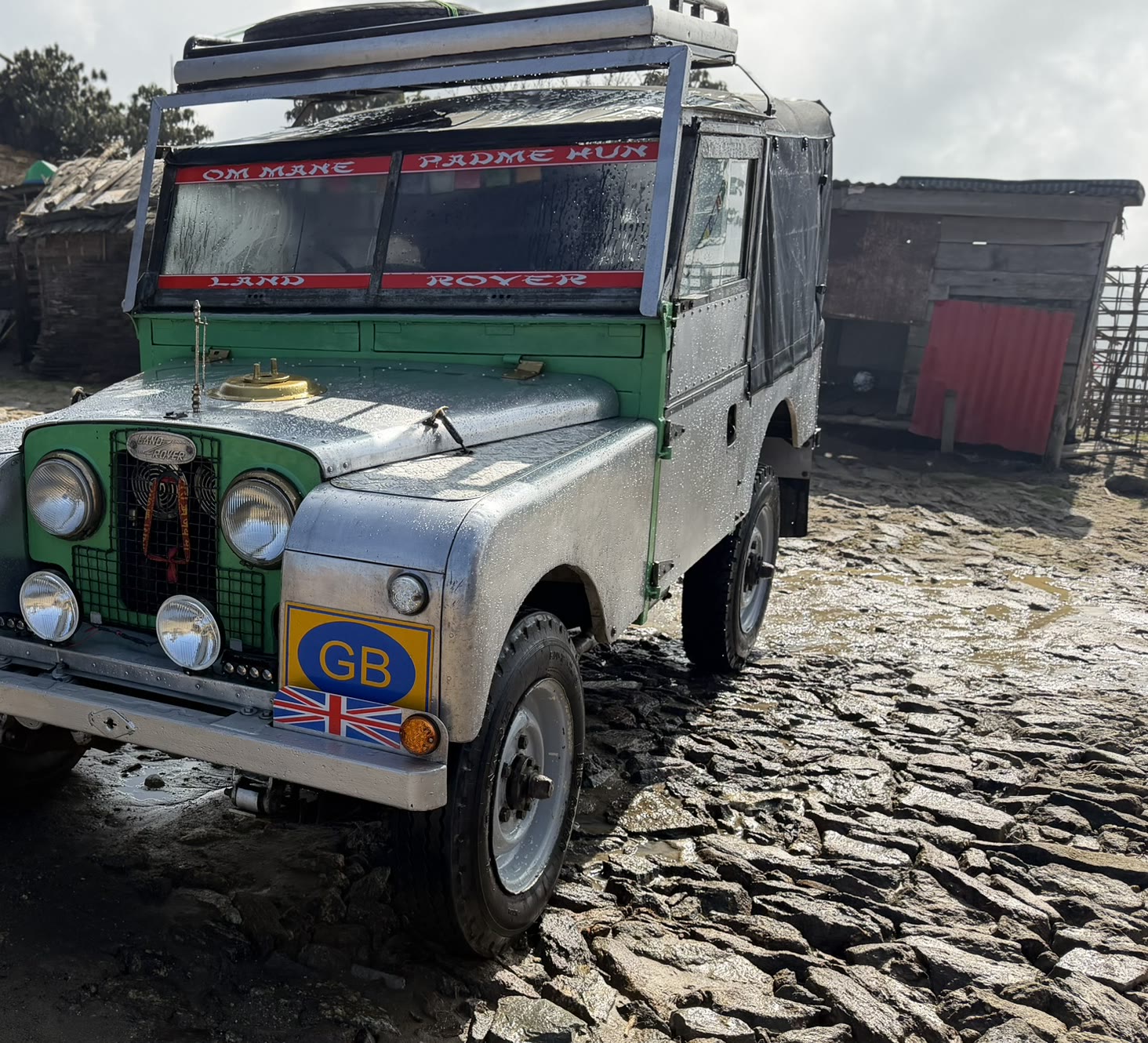
Options for the return include retracing the ridge, descending to Sirikhola and Rimbik, or descending via Gorkey and Rammam. A four-wheel-drive road also reaches Sandakphu, so travellers who prefer not to walk can enjoy the ridge by vehicle.
Rules and etiquette
Visitors follow the trail with a guide, carry out rubbish and keep to the path, since plants at these heights grow slowly. India Tiger Safari would be delighted to design your fully private Singalila journey: a bespoke route along the ridge that suits you best, with curated stays, a private vehicle and a naturalist guide devoted to your party.
Mammals and Birds
The lists below are representative and not complete. More than 120 bird species have been recorded in the park.
Mammals
- Red Panda
- Himalayan Black Bear
- Leopard
- Clouded Leopard
- Leopard Cat
- Serow
- Takin
- Barking Deer
- Wild Boar
- Yellow-throated Marten
- Indian Pangolin
- Pika
Birds
- Satyr Tragopan
- Blood Pheasant
- Kalij Pheasant
- Himalayan Vulture
- Scarlet Minivet
- Brown Parrotbill
- Fulvous Parrotbill
- Rufous-vented Tit
- Fire-tailed Myzornis
- Golden-breasted Fulvetta
Accessibility
Singalila is reached through Darjeeling and the small hill village of Manebhanjan, the gateway to the ridge. The road climbs through tea estates and forest, and it is part of the adventure. Times below are approximate.
Train
| Station | Distance and road time to Manebhanjan | Why use it |
|---|---|---|
| New Jalpaiguri (NJP) | About 90–100 km; roughly three to four hours | The main railhead for the region, with direct trains from Kolkata, Delhi, Guwahati and beyond |
| Ghum | About 30 km; roughly an hour | On the heritage Darjeeling Himalayan Railway, the famous toy train, and close to the ridge |
Air
| Airport | Distance and road time | Onward transport |
|---|---|---|
| Bagdogra (IXB) | Under 100 km; three to four hours | Private transfer through Siliguri, Kurseong and Ghum |
| Kolkata (CCU) or Delhi (DEL) | Connecting flights to Bagdogra | Regular scheduled flights |
Bagdogra is the nearest airport with regular flights and is well connected to Kolkata and Delhi.
Road
Darjeeling (about 51 km, one and a half hours). The natural base for a Singalila journey, with tea estates, heritage hotels and excellent food. Guests often spend a night here before starting the ridge.
Siliguri (about 90 km, three to four hours). The main gateway on the plains, with rail and air connections.
Ghum (about 30 km, around an hour). A quick approach from the Darjeeling side of the ridge.
The roads are winding, so a private transfer with an experienced driver is the most comfortable way to travel. A four-wheel-drive road also reaches Sandakphu.
Accommodation
Stays on the Singalila Ridge range from simple mountain huts to comfortable homestays, with heritage lodges in Darjeeling at each end. This guide describes the character of each option rather than ranking properties.
Trekkers' huts and guest houses
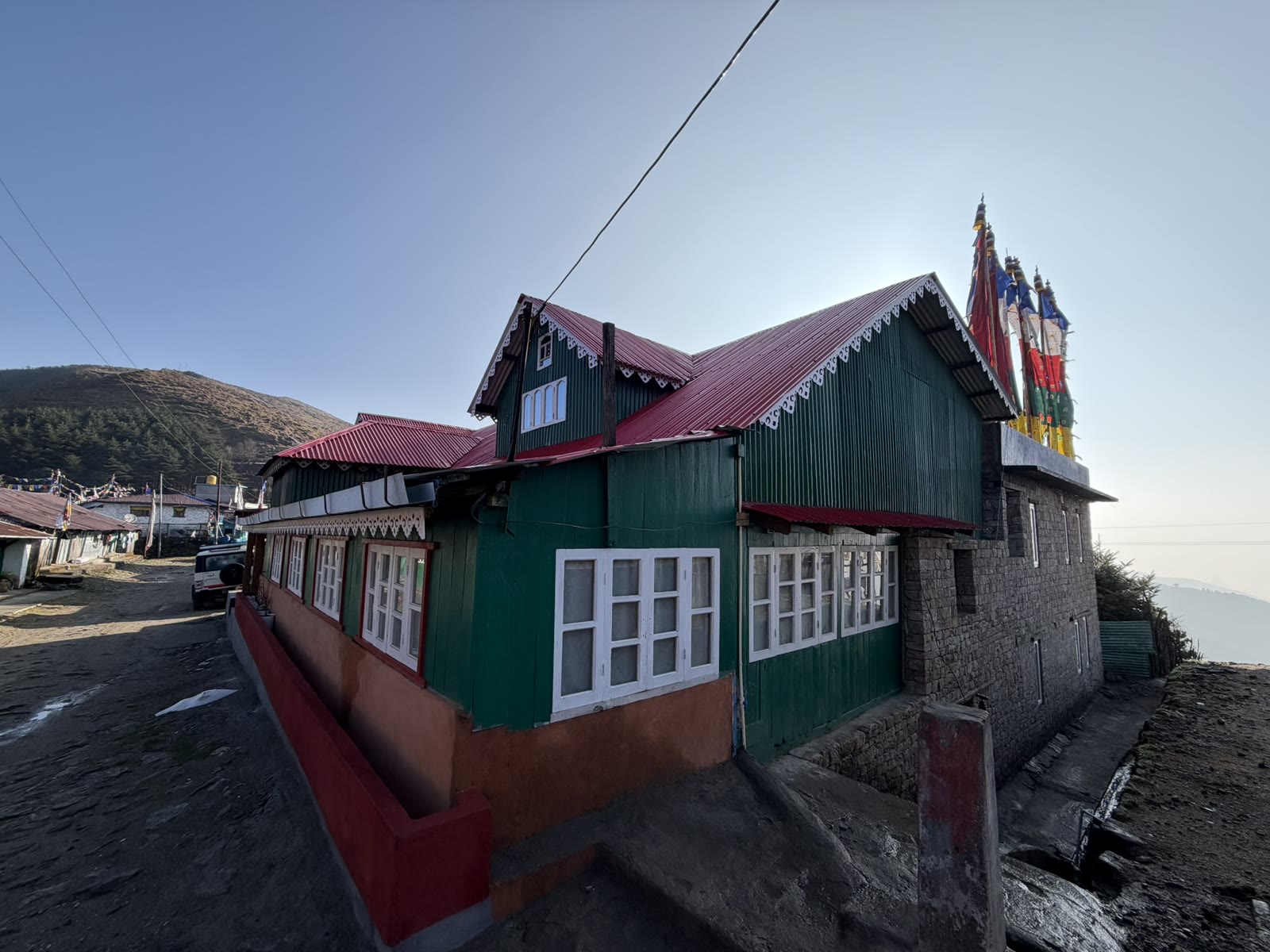
Simple guest houses and huts at Tonglu, Gairibans, Sandakphu, Phalut and Kalipokhri offer warm blankets, hot meals and the chance to wake up to the ridge. They are basic and full of atmosphere, and they place you where the views begin.
Homestays
Families in Tumling, Kalipokhri and Manebhanjan welcome guests into wood-and-stone homes, with local food such as momos, dal bhat and butter tea, and a warm kitchen fire. Homestays support local families.
Luxury and boutique lodges
In and around Darjeeling, tea-estate bungalows and boutique lodges offer heated rooms, fine dining and quiet gardens. They are an excellent base for acclimatising before the ridge and for recovering afterwards.
Camps
Guided camping is a popular way to explore the ridge, with tents, camp kitchens and expert support. The park is one of the leading family camping destinations in the Eastern Himalayas.
Choosing well
- Proximity: Huts and homestays put you on the ridge, while Darjeeling offers comfort and easy logistics.
- Dining: Meals are simple and warming on the ridge, and more varied in Darjeeling.
- Guiding: Local guides and porters know every stage of the trail.
- Families: Camping and vehicle-supported itineraries suit families with older children.
India Tiger Safari's bespoke private itineraries pair each stage of the ridge with a curated stay.
People Also Visit
Singalila lies far to the east, so its natural companions are other Himalayan destinations reached through Delhi or Kolkata.
Hemis National Park
Hemis pairs the Eastern Himalaya with the Trans-Himalaya of Ladakh. Red pandas in rhododendron forest give way to snow leopards on stark rock, and the two are usually linked by flights through Delhi. Together they show the range of Himalayan wildlife, from misty ridges to high-altitude desert.
Jim Corbett National Park
Corbett is the Himalayan foothills at lower elevations, with sal forest, the Ramganga river valley and elephants. It is a natural warm-weather extension to a Singalila journey, connected by a flight to Delhi and a road transfer of about a day.
Sundarbans National Park
Travellers routing through Kolkata to reach Singalila can extend the same journey south to the Sundarbans, trading high-altitude ridgelines for the world's largest mangrove delta. Where Singalila offers ridge-top views of Kanchenjunga and Himalayan birding, the Sundarbans is explored entirely by boat, tracking tiger signs and estuarine wildlife through tidal creeks. India Tiger Safari can combine the two into a single private eastern-India itinerary — mountains and delta on one trip — with a naturalist guide and private transport arranged for each leg.
Singalila National Park FAQs
What is the best time to visit Singalila National Park?
The two best windows are spring, from March to May, when rhododendrons bloom, and post-monsoon, from mid-September to early December, when skies clear and views of the peaks are at their best. The park closes from 16 June to 15 September for the monsoon. Winter brings cold, snow and crisp mornings.
How many days do you need in Singalila?
Four to six days on the ridge is ideal, with an extra night or two in Darjeeling to acclimatise and enjoy the tea estates. That allows a relaxed pace between stages and time to watch for wildlife. India Tiger Safari's bespoke itineraries match stages and stays to your dates.
Can you see red pandas in Singalila?
Singalila holds a resident red panda population of about 42 (2019), and the park has been a centre for red panda reintroduction. Red pandas are shy and spend much of the day in bamboo and fir, so a sighting is a rare privilege. No sighting can be promised, but the forests are beautiful in themselves.
Do you have to trek to Sandakphu?
No. The classic route is a trek in stages, but a four-wheel-drive road also reaches Sandakphu, so travellers who prefer not to walk can enjoy the ridge by vehicle. Many combine the two, walking the most scenic sections and driving the rest, with a guide throughout.
How do Singalila arrangements work?
Visitors follow the ridge with a local guide, staying in huts, homestays or camps, with entry through the park's checkpoint at Tumling. India Tiger Safari handles guides, vehicles and stays for its private guests, so you can concentrate on the landscape and the animals.
What animals can you see in Singalila?
Red panda is the star, with Himalayan black bear, leopard cat, barking deer, serow and pika also present. Clouded leopard and leopard live here but are rarely seen. More than 120 bird species include satyr tragopan, blood pheasant, kalij pheasant and the fire-tailed myzornis.
How do you reach Singalila National Park?
Bagdogra airport, under 100 km from the park, is the nearest with regular flights, and New Jalpaiguri is the main railhead. From either, Manebhanjan is a drive of roughly three to four hours, or about one and a half hours from Darjeeling. A private transfer is the most comfortable option.
Is Singalila suitable for families?
Yes, for families with older children who enjoy walking. Camping is popular, and the vehicle road to Sandakphu allows a gentler option. Days are quiet and scenic, with warm homestay evenings. A private guide lets families set a comfortable pace.
What should you wear on a Singalila journey?
Dress in layers: thermal base layers, a fleece, a down jacket and a waterproof shell, with sturdy trekking boots, warm gloves and a hat. Nights at Sandakphu can be very cold. Sun protection matters at altitude, and binoculars make the birds and distant peaks richer.
Can you see Kanchenjunga and Everest from Singalila?
Yes, on clear mornings the ridge gives wide views of Kanchenjunga and Everest, with Lhotse and Makalu beside them, best from Sandakphu at sunrise. October to early December and March to April usually offer the clearest skies. Cloud can come and go, so a few mornings on the ridge help.