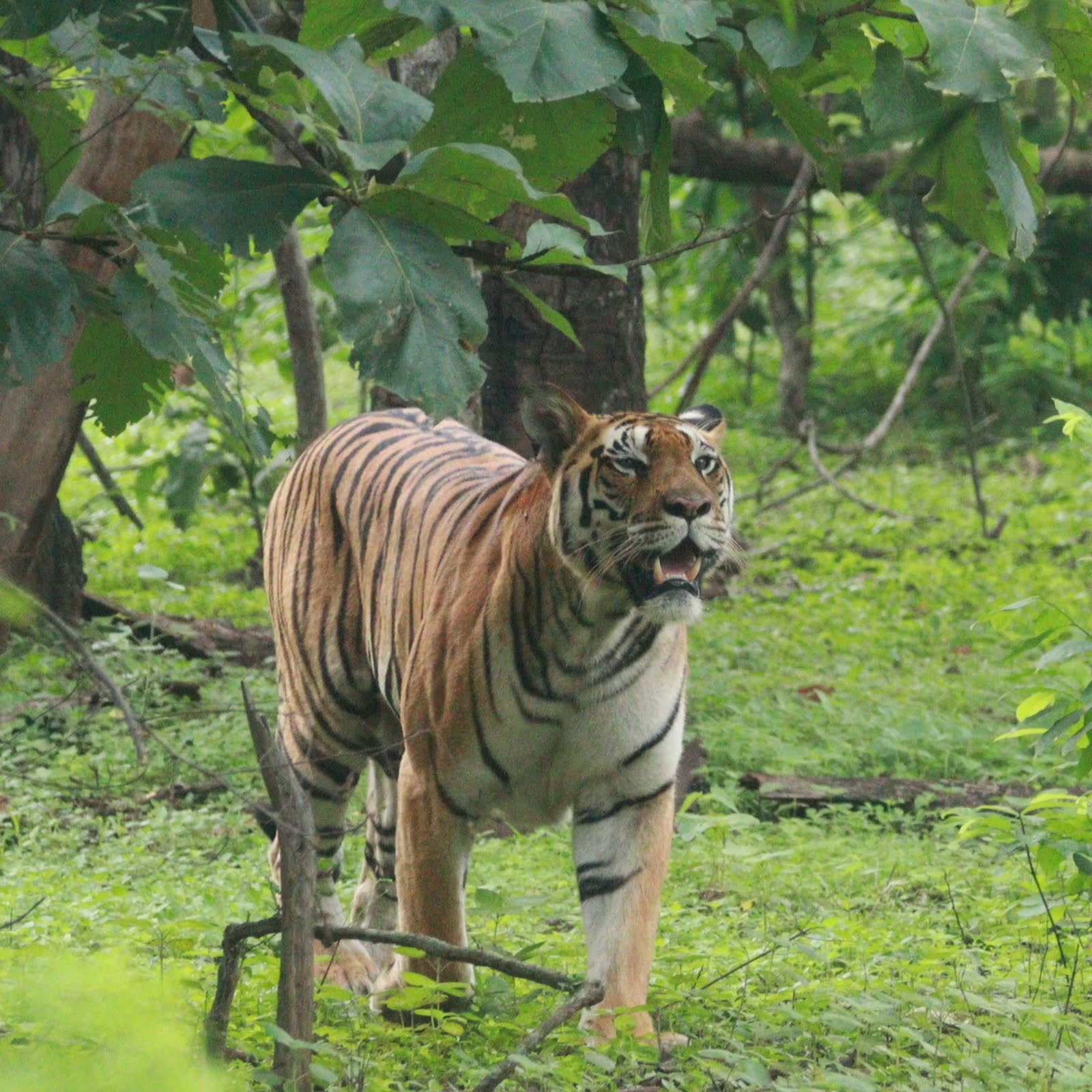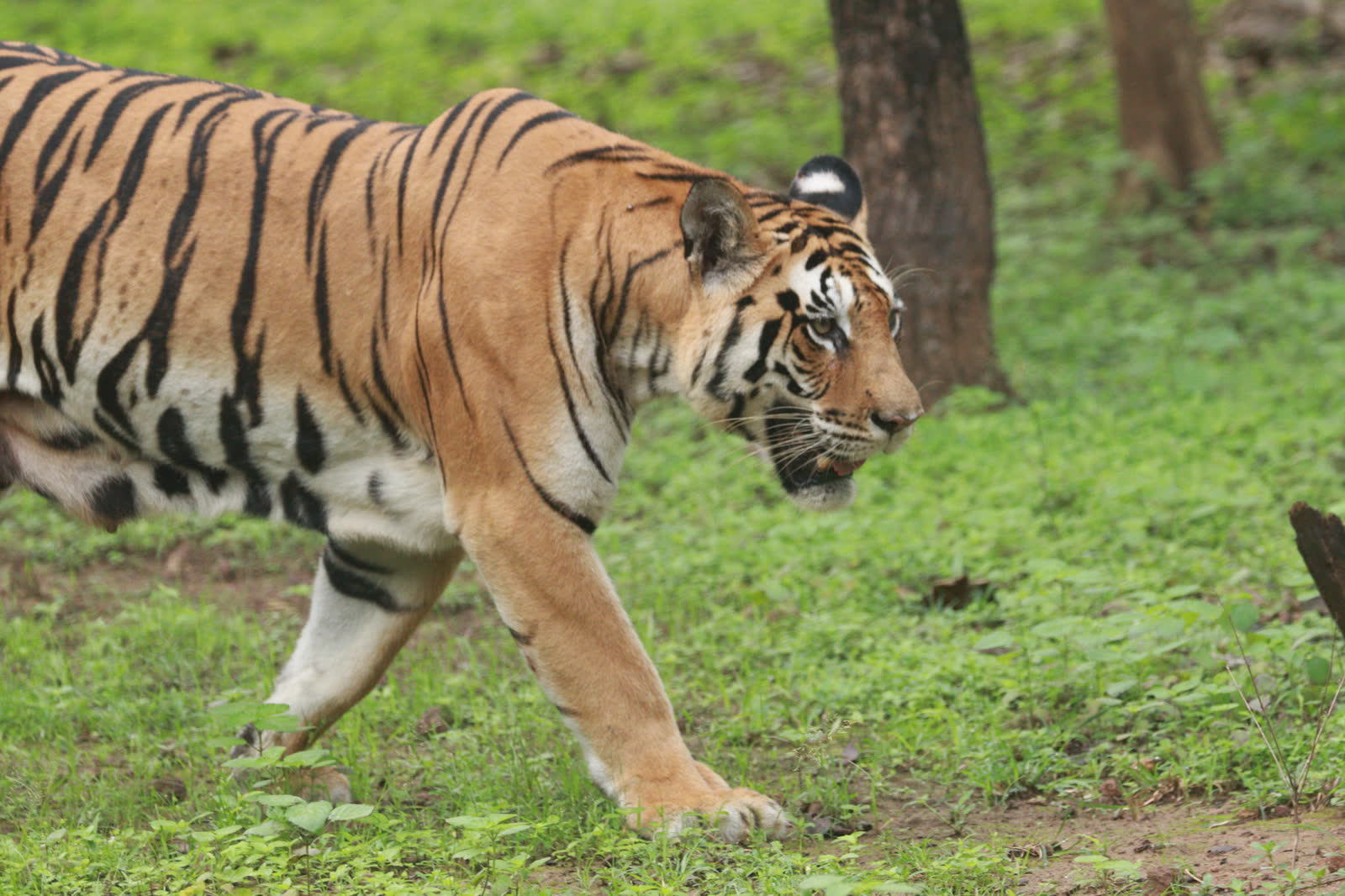
Pench National Park: Safari Guide
The Jungle Book landscape, dhole, and the tigress Collarwali
About Pench National Park
Pench National Park lies across the Seoni and Chhindwara districts of southern Madhya Pradesh, on the border with Maharashtra, and it takes its name from the Pench River that winds through it. Officially Priyadarshini Pench National Park, it covers about 293 km² and forms the core of Pench Tiger Reserve together with the Mowgli Pench Wildlife Sanctuary. The reserve continues across the state line as Pench Tiger Reserve in Maharashtra, giving one of central India's most extensive forest landscapes.
The area was protected as a wildlife sanctuary in 1977 and became a national park in 1983. Since 1992 it has been part of the tiger reserve, whose Madhya Pradesh core covers about 411 km². The distinction is easy to hold: the national park is the historic heart, the tiger reserve is the wider protected landscape, and the safari gates lie on both the Madhya Pradesh and Maharashtra sides.
The terrain is gently rolling, at about 425 to 620 m, with dry deciduous forest dominated by teak mixed with saja, haldu, salai, amla, mahua and bamboo. Grassy clearings, rocky outcrops and the reservoir of Totladoh Dam add variety, and the Pench River and its streams keep the forest green through the dry months.
Pench has a special place in wildlife literature. It is one of the places believed to have inspired Rudyard Kipling's The Jungle Book, and Mowgli's forest is part of the reserve's identity. It was a filming location for the BBC series Tiger: Spy in the Jungle, and it was the home of Collarwali, the celebrated tigress who raised a record number of cubs.
The reserve is known for strong herbivore densities and a healthy tiger and leopard population, as well as some of central India's most reliable dhole sightings. More than 40 mammal species and over 210 bird species have been recorded.
What to expect: morning and afternoon jeep drives through teak and bamboo forest and along stream beds, with tigers, dhole, gaur, sambar and langurs the highlights. Sightings, while never promised, come in a forest that feels classic and unhurried.
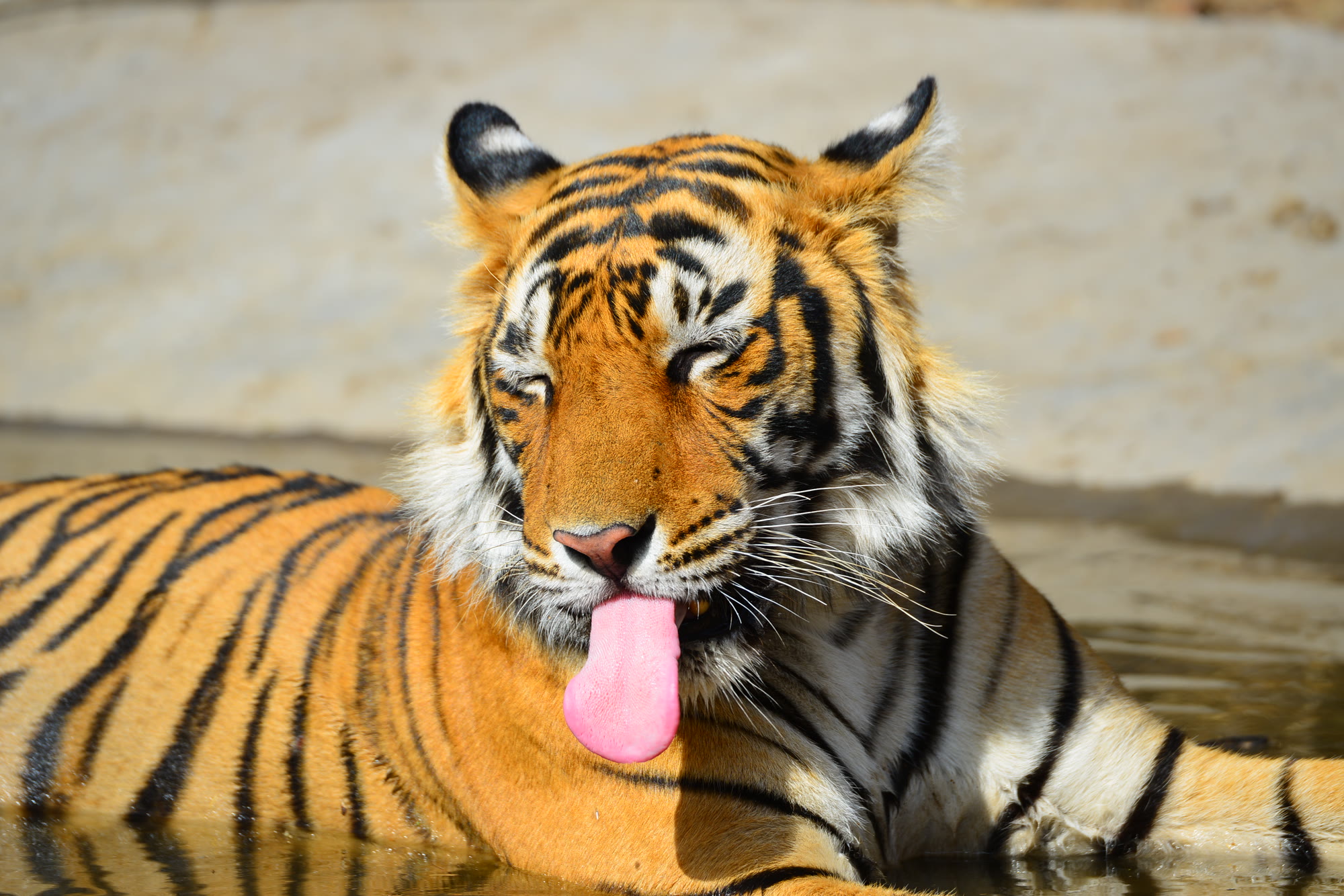
Facts About Pench National Park
| Information | Details |
|---|---|
| Location | Seoni and Chhindwara districts, on the Madhya Pradesh–Maharashtra border |
| State | Madhya Pradesh, with the reserve continuing into Maharashtra |
| Established | Sanctuary 1977; national park 1983; tiger reserve core from 1992 |
| Area | National park about 293 km²; core of the Madhya Pradesh tiger reserve about 411 km² |
| Protected Area Type | National park within a tiger reserve, together with Mowgli Pench Wildlife Sanctuary |
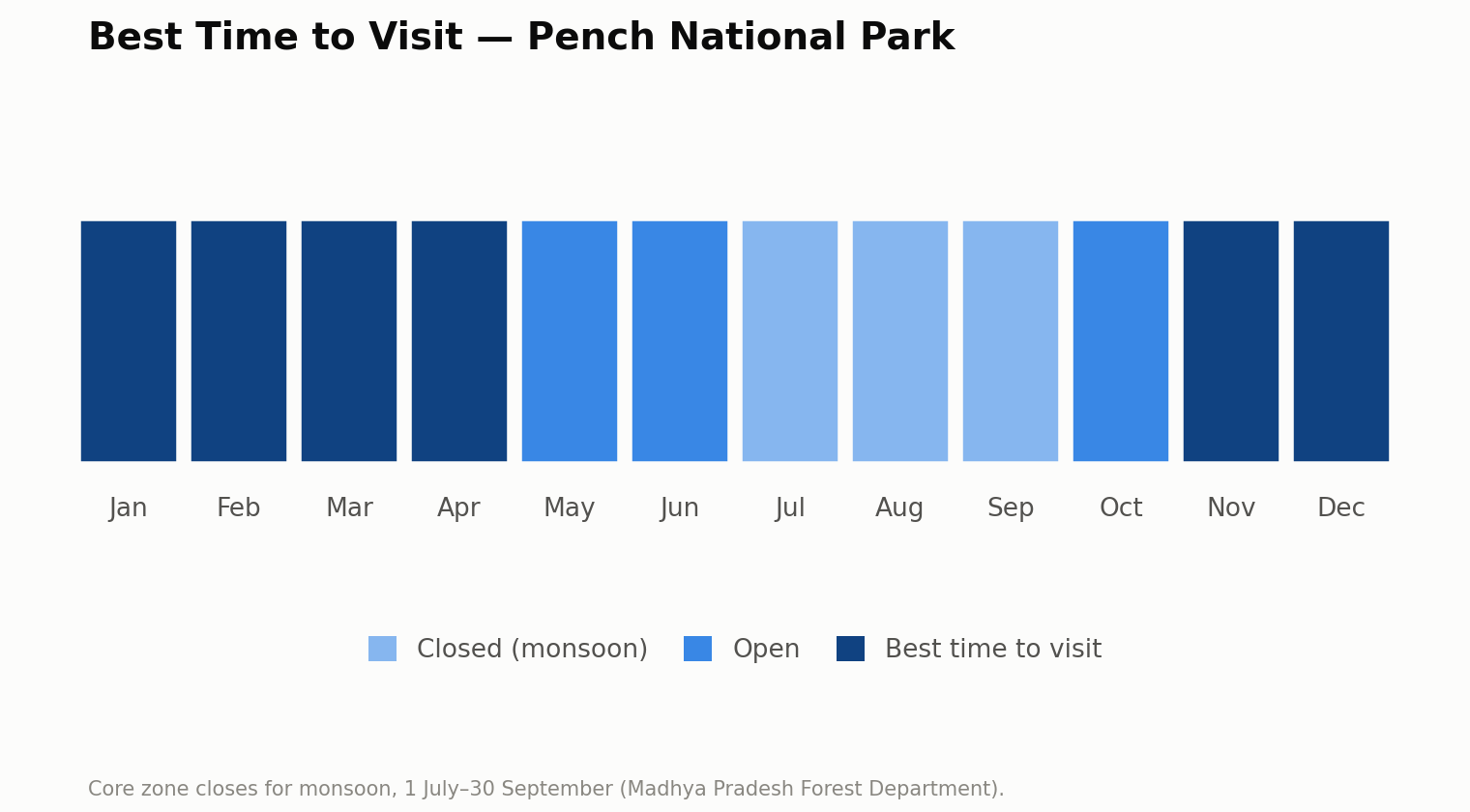
| Functional Days | Two daily shifts, from 1 October to 30 June |
| Annual Closure | Monsoon closure from 1 July to 30 September; selected buffer routes may remain open |
| Weekly Offs | Each gate has a weekly rest day, and Madhya Pradesh core zones typically rest on Wednesday afternoons |
| Best Time to Visit | November to April, with May and June best for waterholes |
| Recommended Safari Duration | Two to three nights with three to five drives across two or more gates |
| Vegetation | Dry deciduous teak forest, bamboo, grassland and river valley |
| Elevation | About 425–620 m |
| Major Wildlife | Tiger, leopard, dhole, sloth bear, gaur, chital, sambar |
| Famous For | The Jungle Book landscape, dhole, and the tigress Collarwali |
Functional days. Drives run in a morning and an afternoon shift that follow the season, with mornings starting around 6:00 to 6:30 am in cooler months and earlier in summer.
Yearly off. The reserve rests through the monsoon, reopening on 1 October when the forest is fresh and green.
Weekly offs and rules. Rest days differ by gate and side, so a permit is tied to a gate, date and shift. Only authorised jeeps enter the park.
Tiger Density and Other Major Species
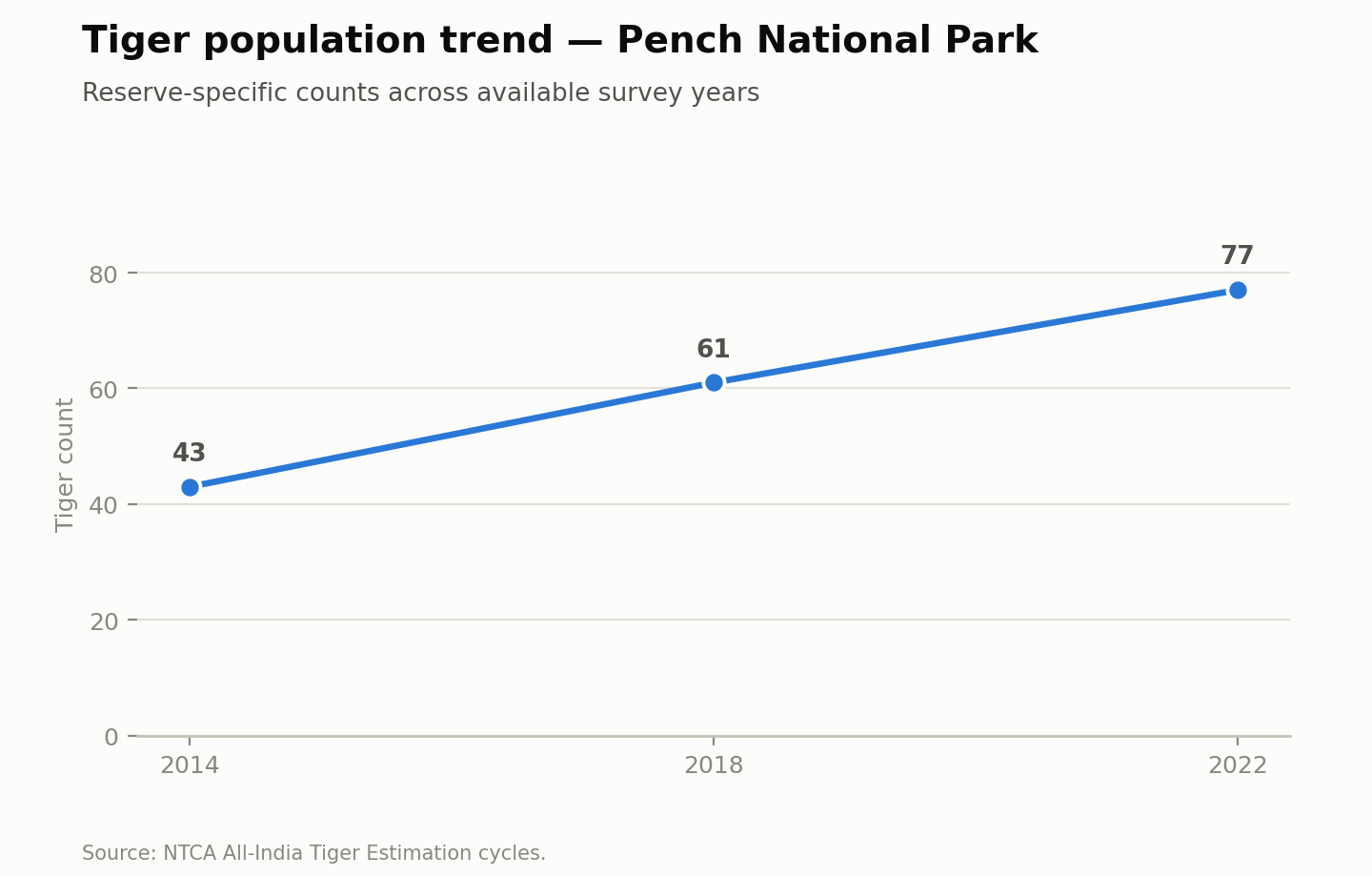
Pench is one of the leading tiger reserves of central India, and its Madhya Pradesh side has held a strong population in recent census cycles.
| Year | Area | Estimated tigers |
|---|---|---|
| 2022 | Pench Tiger Reserve, Madhya Pradesh | About 77 |
| 2022 | India | 3,682 (range 3,167–3,925) |
| 2022 | Madhya Pradesh | 785, the most of any state |
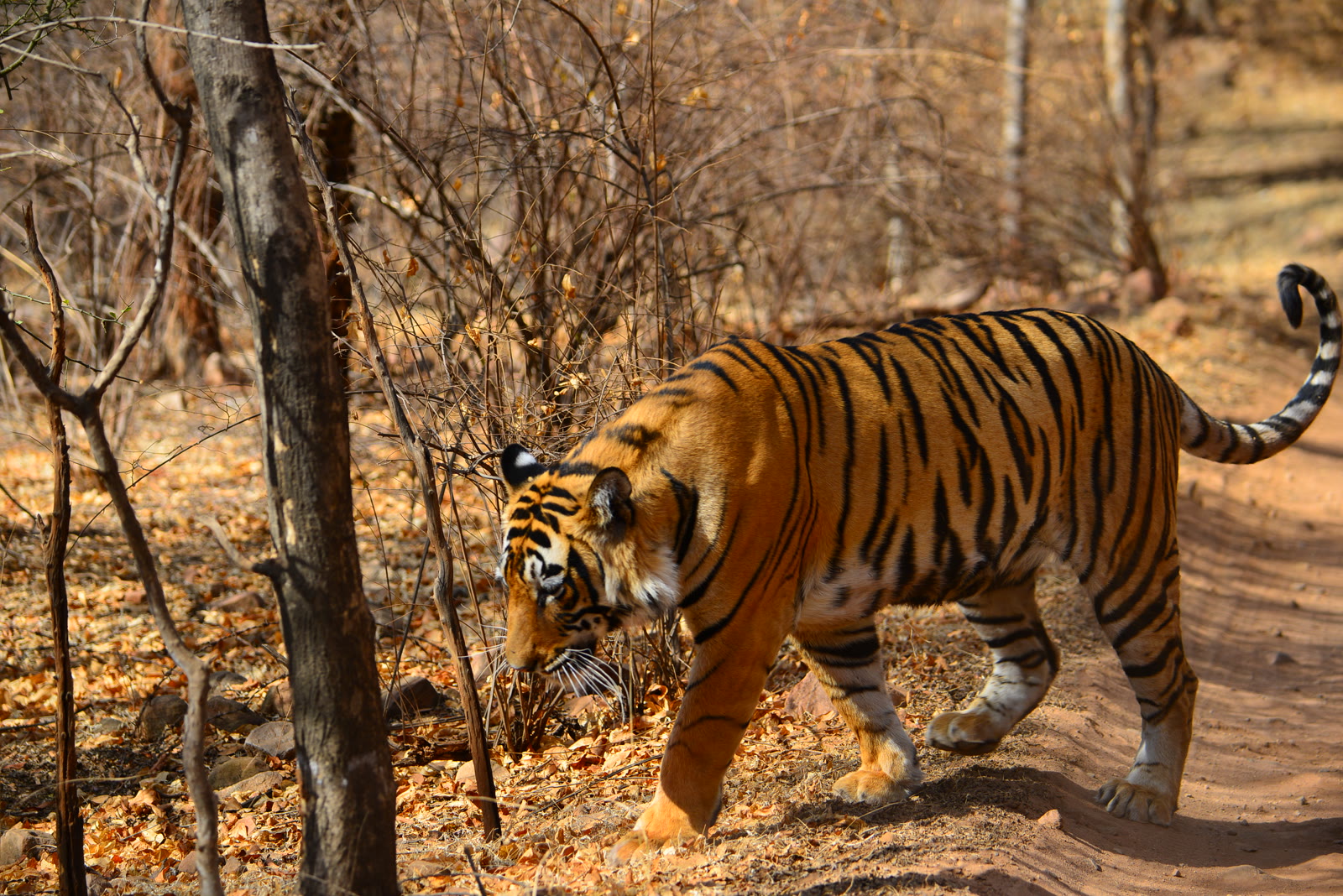
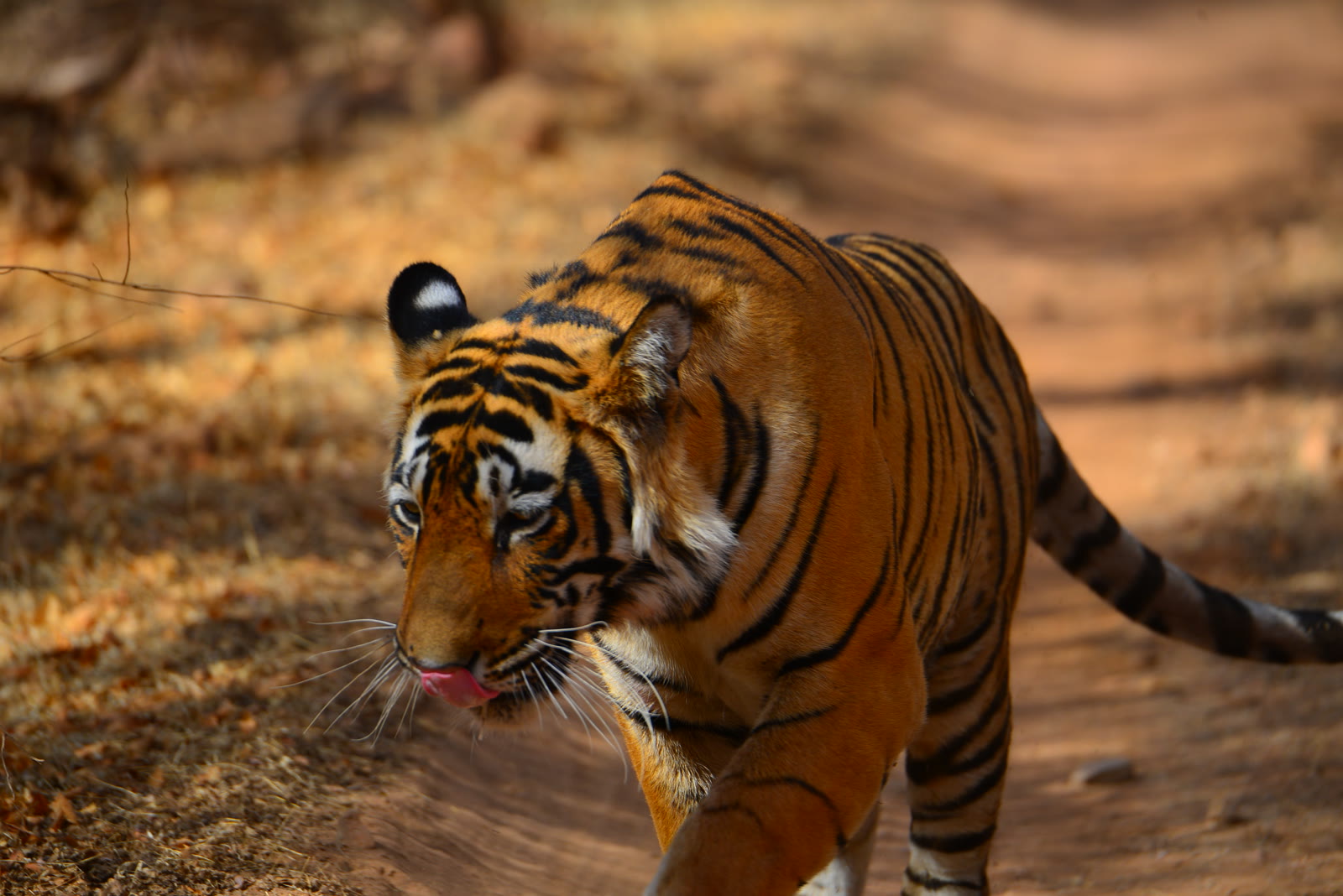
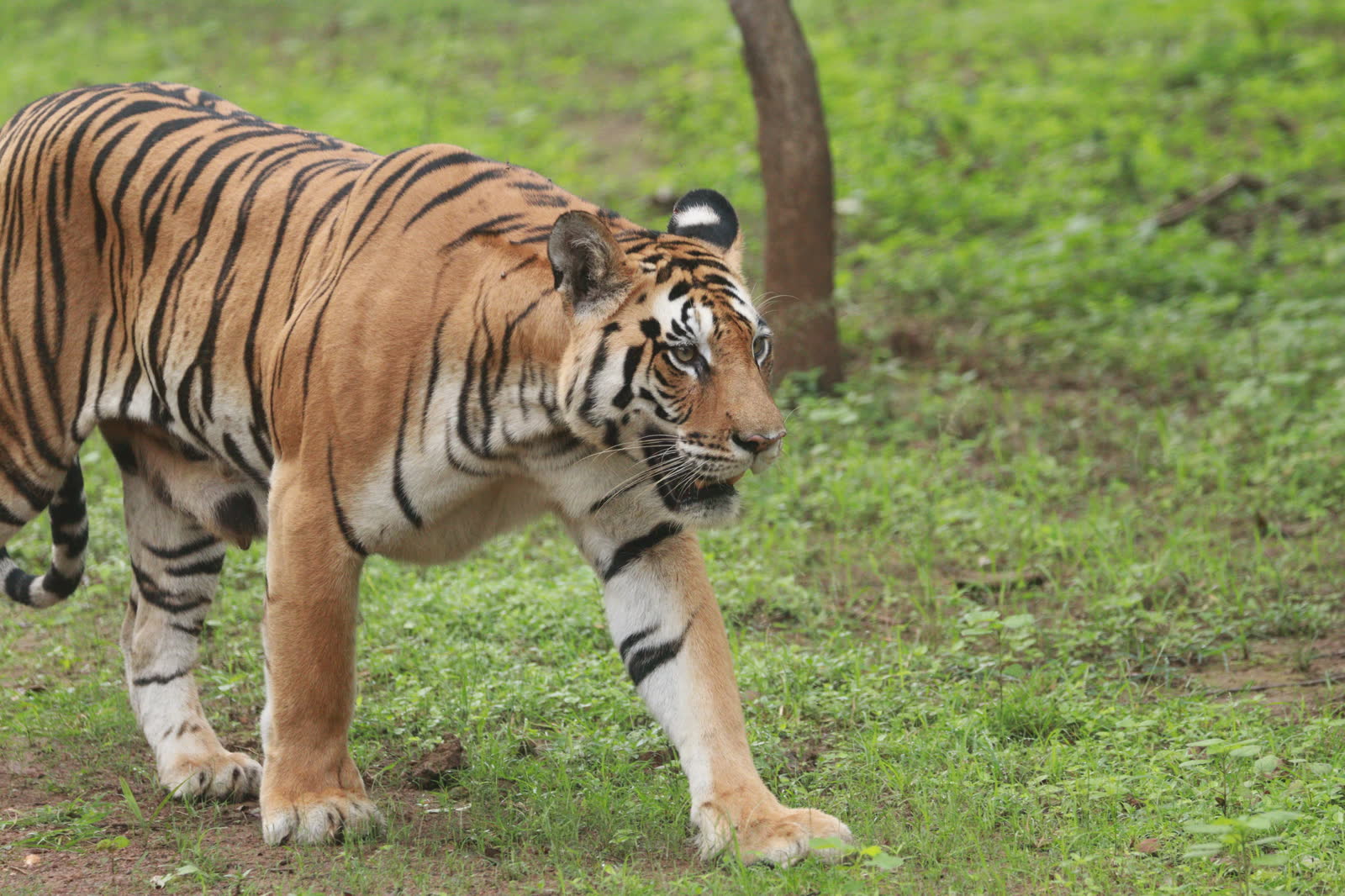
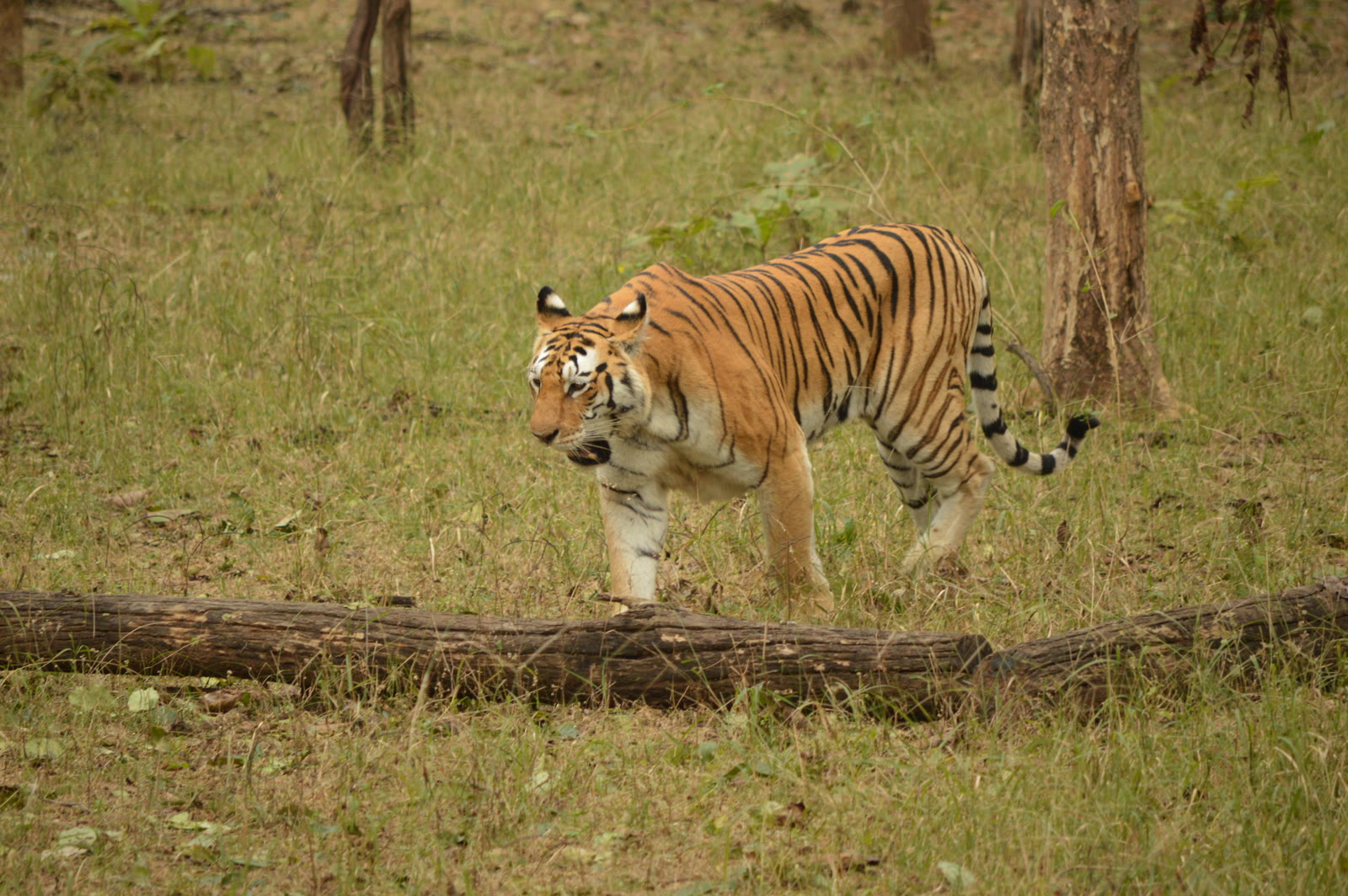
Pench is part of a connected central Indian landscape, linked to Kanha by forest corridors along the highway, and tigers move through these routes. The reserve is famous for Collarwali, the tigress who raised a record number of cubs and became an icon of tiger conservation across the country.
Sightings are frequent by central Indian standards, especially at Turia, Karmajhiri and Sillari, where habitat is rich and prey plentiful. Dhole, or wild dogs, are seen on a good share of drives and are a Pench speciality. No sighting can be promised, but the abundance of prey makes every drive lively.
Other species
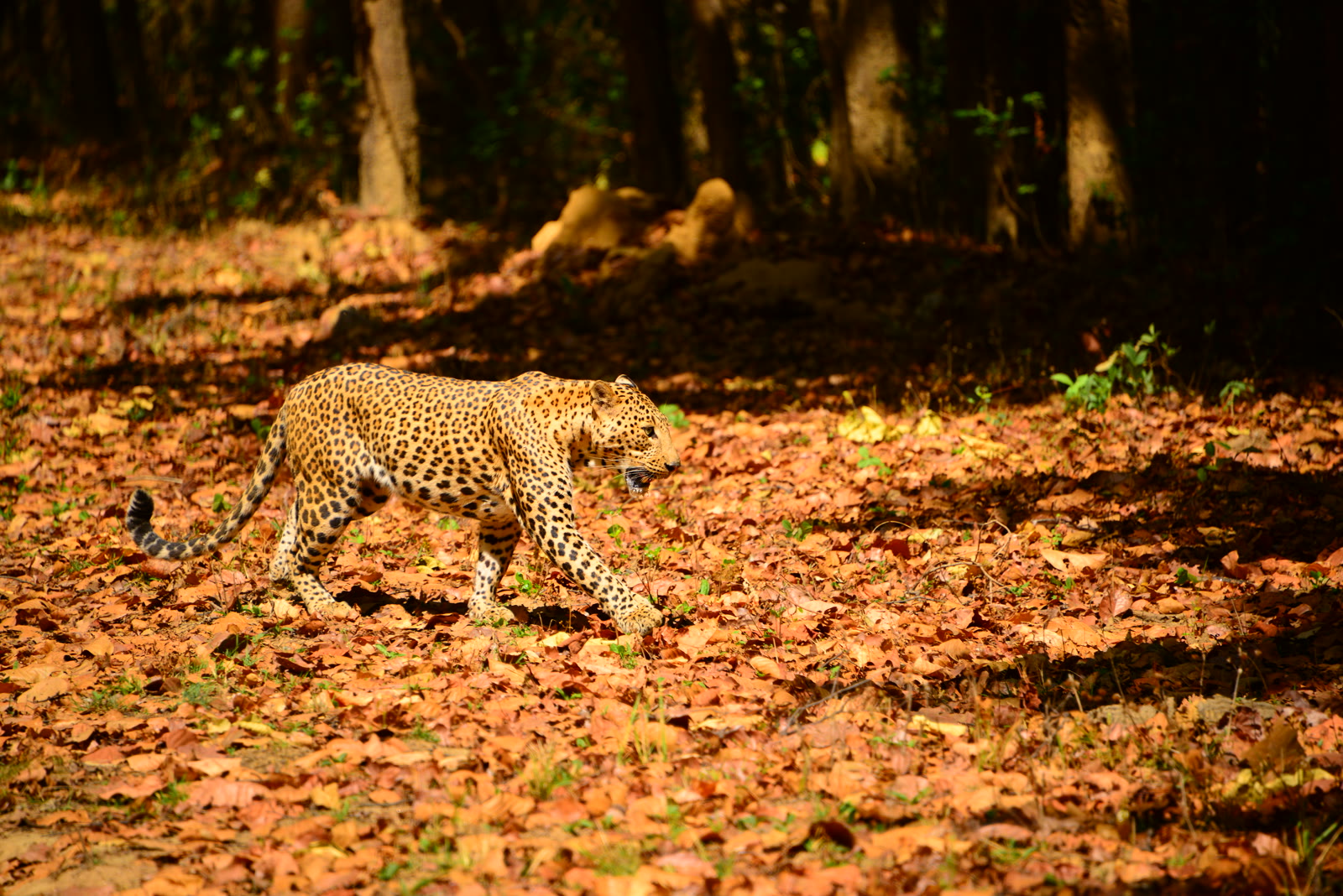
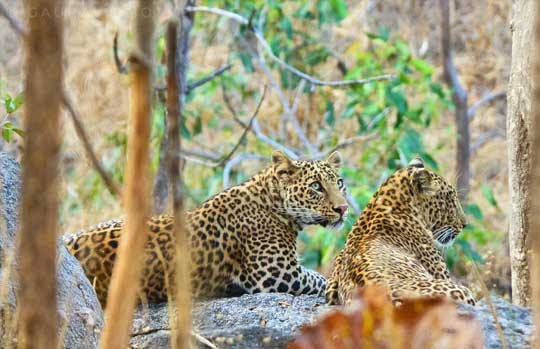
- Leopard: Present and seen occasionally, especially in rocky areas.
- Dhole (wild dog): Seen regularly, in packs that hunt chital and sambar.
- Sloth bear: Seen occasionally, often near mahua trees in the hot season.
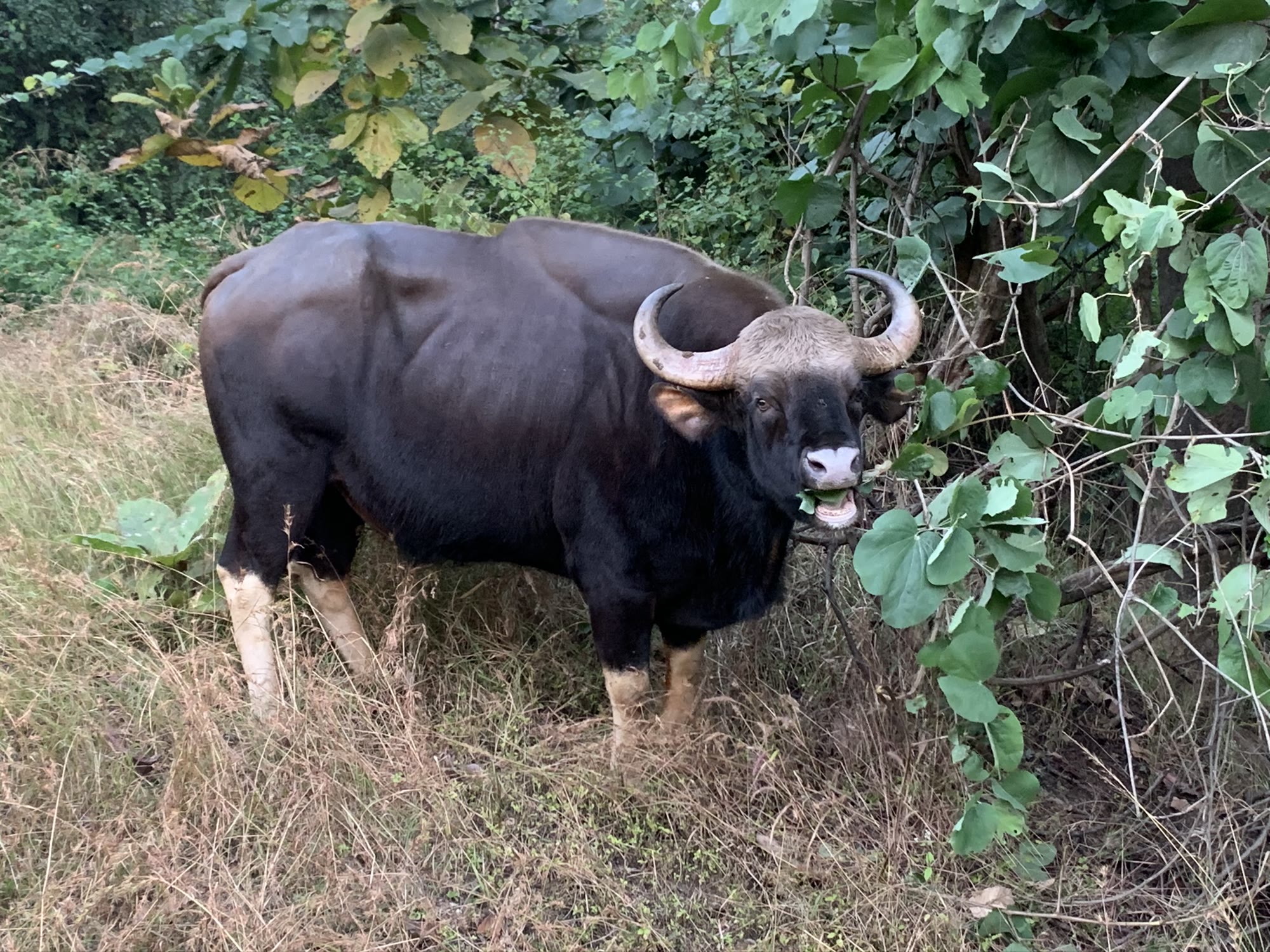
- Gaur: Seen regularly in the forest and clearings.
- Prey base: Chital and sambar are seen on almost every drive, with nilgai, four-horned antelope, chinkara and wild boar also present.
- Primates: Common langurs are everywhere, and their alarm calls often signal a predator.
- Birds: More than 210 species, with peafowl, junglefowl, crested serpent eagle and water birds around Totladoh.
Safari Zones in Pench National Park
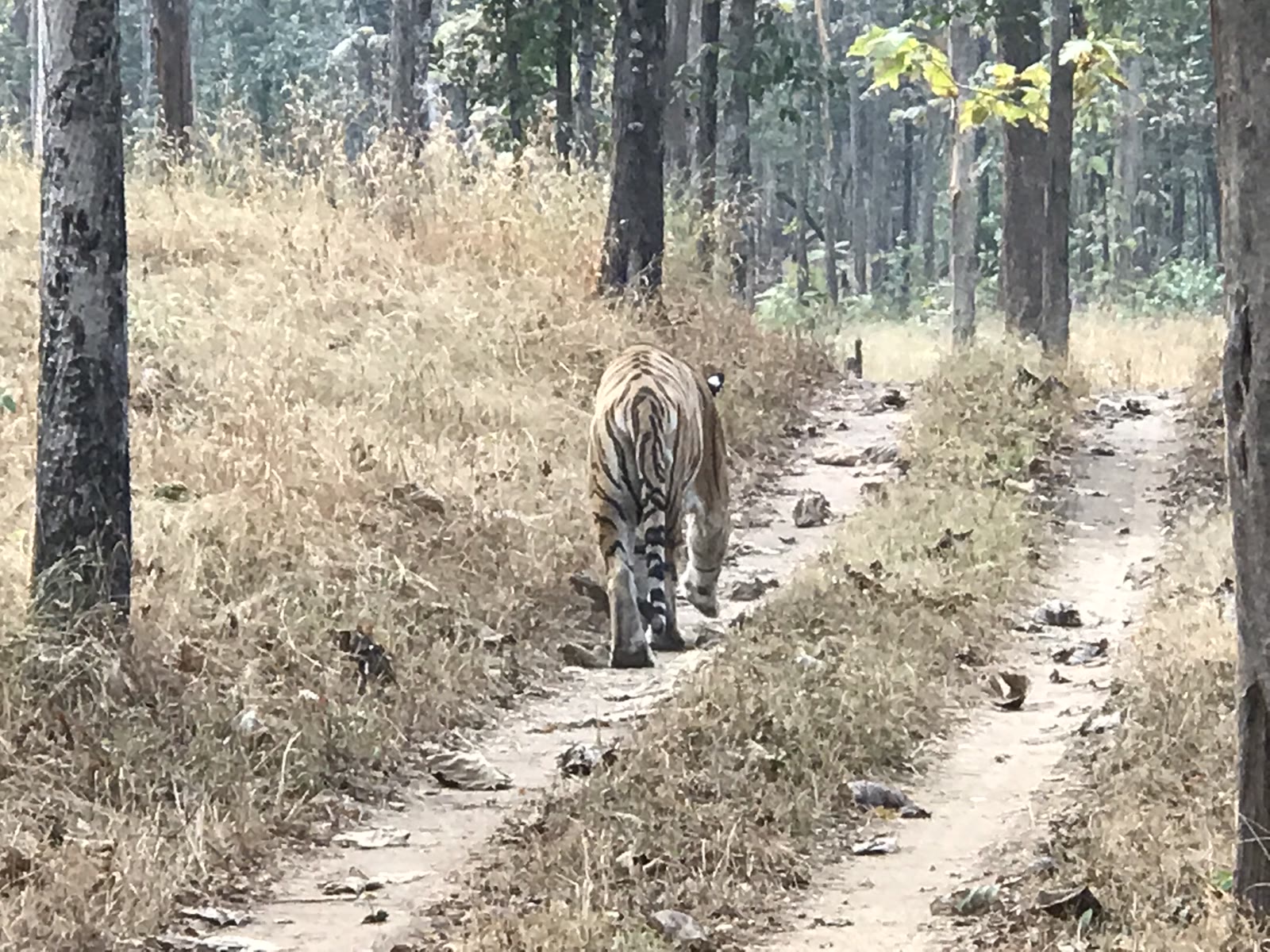
Pench is explored through a set of gates on both the Madhya Pradesh and Maharashtra sides. Each gate leads to its own routes, and a permit is tied to a gate. No gate can promise a sighting.
| Gate | Side | Character |
|---|---|---|
| Turia | Madhya Pradesh | The busiest and most visited core gate, close to the highway |
| Karmajhiri | Madhya Pradesh | A popular core gate with rich forest and strong tiger interest |
| Jamtara | Madhya Pradesh | Quieter dense forest, reached via Karmajhiri |
| Rukhad and Teliya | Madhya Pradesh buffer | Mixed habitat and fewer vehicles |
| Sillari | Maharashtra | Dense bamboo and teak, waterfalls and Totladoh views |
| Khursapar | Maharashtra | Undulating terrain with gaur, chowsingha and chinkara |
| Chorbahuli | Maharashtra | A quieter core gate opened in 2013 |
Turia
Turia is the most visited gate in Pench, lying almost on the state border and close to the highway. Its routes are rich in prey and have long been productive for tigers, leopards and dhole, and the scenery is among the most picturesque in the reserve.
Karmajhiri
Karmajhiri is a favourite core gate, known for high tiger interest and a mix of teak, bamboo and stream beds. It offers a genuine sense of forest, with sambar, chital and gaur frequent.
Jamtara
Jamtara offers dense forest, with barking deer, sloth bear and wild dogs recorded, and is now approached via the Karmajhiri gate. It suits travellers who prefer quieter drives.
Rukhad and Teliya
These buffer routes have a lower crowd and mixed habitat, with leopards and a strong gaur population at Rukhad. Rukhad also lies on the wildlife corridor between Pench and Kanha.
Sillari
Sillari is the main gate on the Maharashtra side and one of the finest routes in the reserve. The forest is dense with bamboo and teak, with many water bodies and waterfalls and views of Totladoh Dam on the Pench River, and it is good for wild dogs and sloth bear.
Khursapar
Khursapar, about 12 km from Turia, has grown popular for tiger sightings. The terrain is undulating, with gaur, chowsingha and chinkara, and small lakes such as Bakhari add to the interest.
Chorbahuli
Chorbahuli is a peaceful core gate opened to visitors in 2013, and it is ideal for those who prefer quieter drives.
Vehicles and rules
Open jeeps carry small groups with a naturalist. Permits are allotted by gate, so drives across two or three gates give the fullest picture. India Tiger Safari would be delighted to design your fully private Pench safari: a bespoke journey through the gates that suit you best, with curated stays, a private jeep and a naturalist guide devoted to your party.
Mammals and Birds
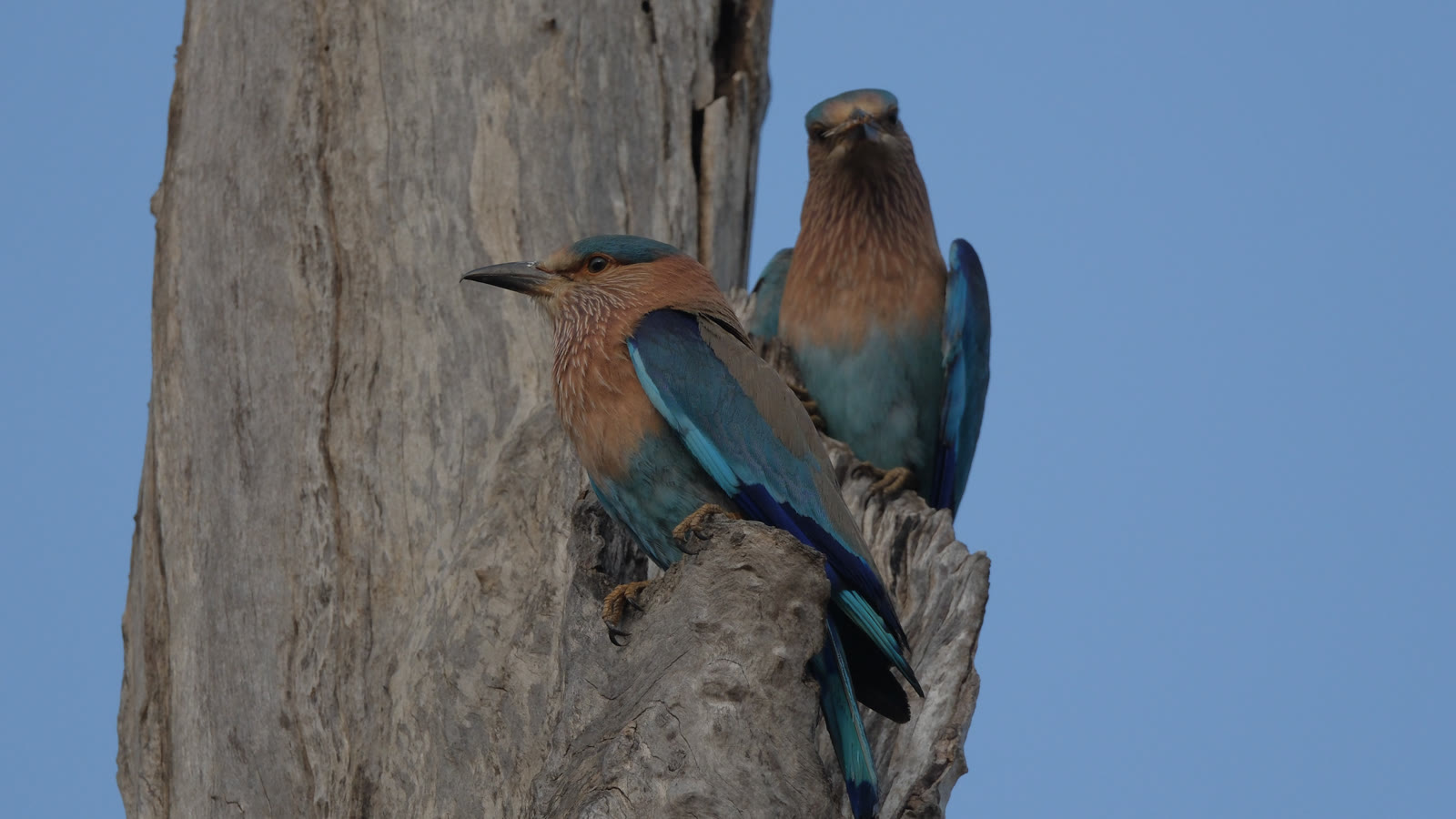
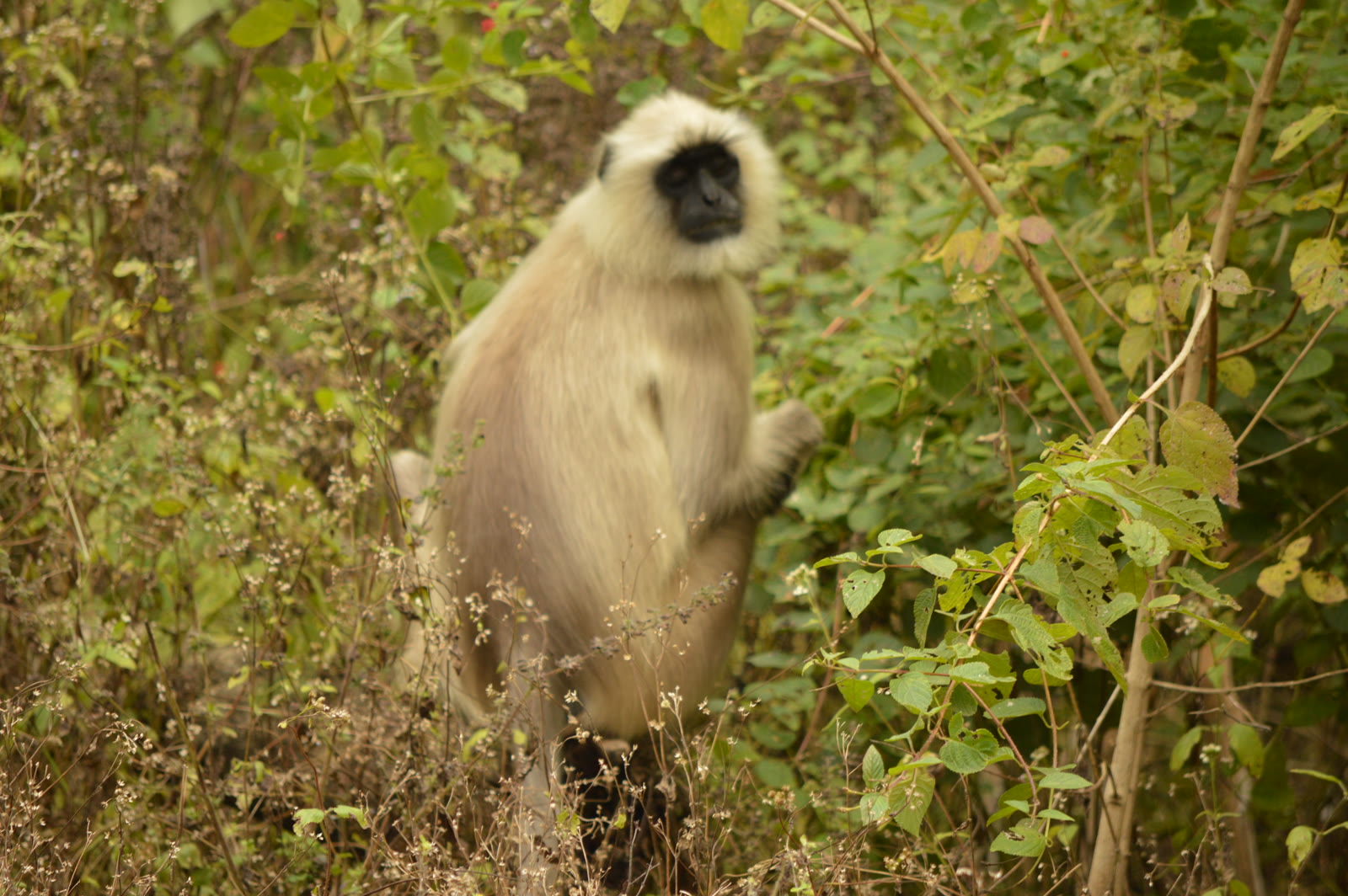
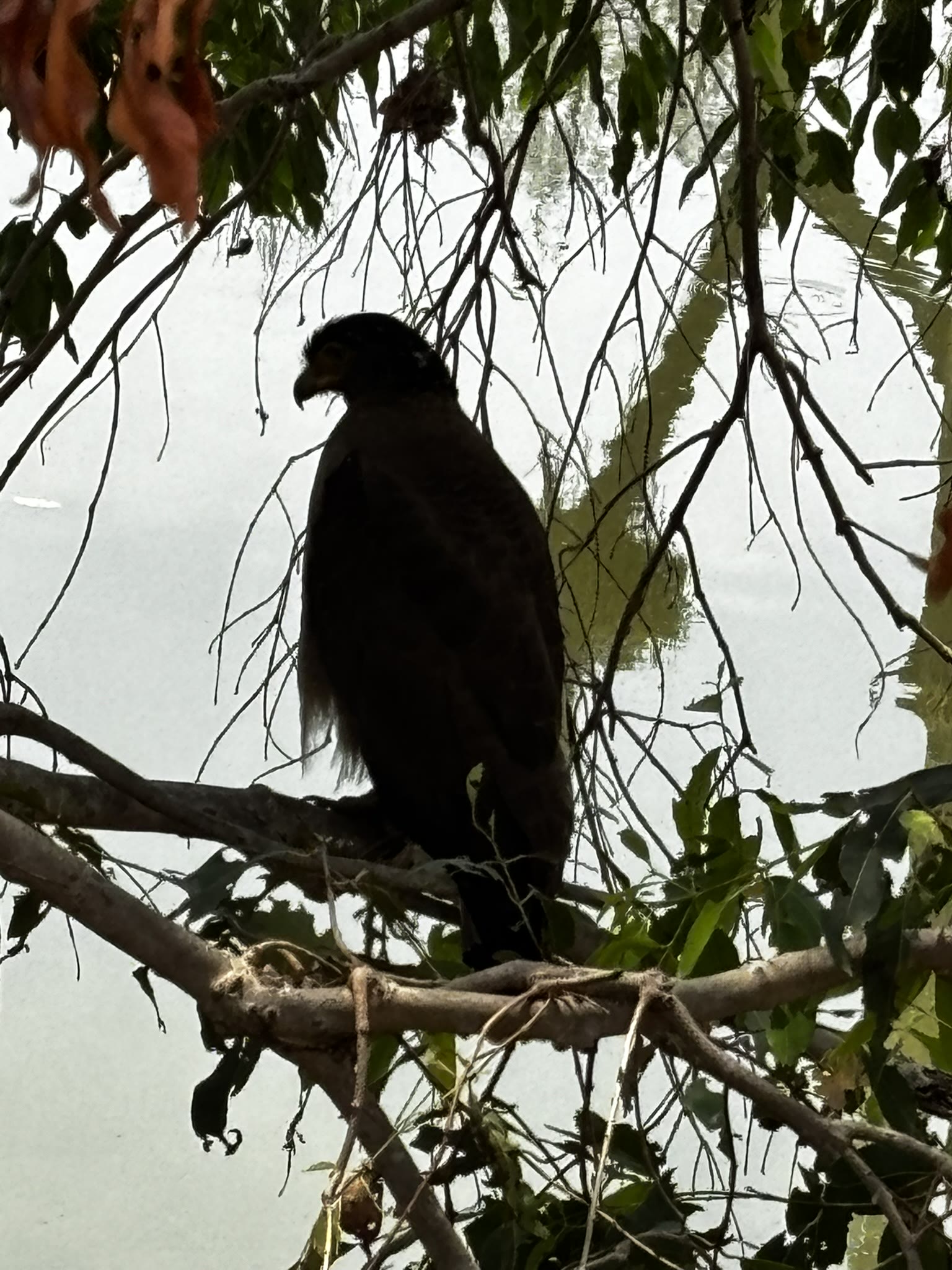
The lists below are representative and not complete.
Mammals
- Tiger
- Leopard
- Dhole
- Sloth Bear
- Golden Jackal
- Chital
- Sambar
- Northern Red Muntjac
- Four-horned Antelope
- Gaur
- Nilgai
- Chinkara
- Wild Boar
- Common Langur
- Rhesus Macaque
- Indian Hare
- Indian Porcupine
Birds
- Indian Peafowl
- Red Junglefowl
- Indian Vulture
- Greater Coucal
- Crimson-breasted Barbet
- Red-vented Bulbul
- Racket-tailed Drongo
- Crested Serpent Eagle
- Changeable Hawk-Eagle
- Indian Roller
- Oriental Magpie Robin
- Lesser Whistling Duck
- Northern Pintail
- Northern Shoveler
- Egret
- Heron
- Minivet
- Oriole
- Wagtail
- Munia
- Myna
- Common Kingfisher
Accessibility
Pench is one of the most accessible tiger reserves in central India, close to Nagpur and on the main highway to Jabalpur. Distances and times are approximate.
Train
| Station | Distance and road time to the park | Why use it |
|---|---|---|
| Nagpur Junction | About 90–95 km to Turia; roughly one and a half to two hours | A major junction with fast trains from Delhi, Mumbai, Chennai and Kolkata |
| Jabalpur Junction | About 190–200 km to Karmajhiri; roughly four hours | A major hub and a natural start for a Kanha and Pench circuit |
Air
| Airport | Distance and road time | Onward transport |
|---|---|---|
| Nagpur (NAG) | About 90–95 km to Turia; one and a half to two hours | Private transfer |
| Jabalpur (JLR) | About 190–200 km; roughly four hours | Private transfer |
Nagpur is the closest and best-connected airport, with regular flights from Delhi, Mumbai, Bengaluru and Hyderabad.
Road
Nagpur (about 90–95 km to Turia, one and a half to two hours). A smooth highway drive, with Sillari about 65–75 km and Khursapar about 80 km from the airport.
Jabalpur (about 190–200 km, four hours). A pleasant drive along the highway, ideal for those arriving from Kanha or Bandhavgarh.
Seoni (about 25–70 km depending on the gate, roughly one hour). The nearest town, with resources for the last leg.
Inside the park, only authorised safari vehicles are used, with a forest guide.
Accommodation
Stays around Pench are set among forest and farmland, with the main clusters near Turia and Karmajhiri on the Madhya Pradesh side and near Sillari and Khursapar on the Maharashtra side. This guide describes the character of each option rather than ranking properties.
Luxury safari lodges
The finest properties offer spacious cottages, private terraces, pools, fine dining and expert naturalists. Many sit close to the gates and face forest or farmland, with mornings that begin with a short drive into the park. They suit couples and small private groups who want comfort between drives.
Boutique lodges and eco-lodges
Smaller lodges and eco-lodges in the forest fringe offer a quieter, more personal stay, with tree-house and cottage-style rooms and warm, home-style meals.
Resorts and mid-range hotels
A choice of resorts with gardens and pools serves families and groups, and is practical for early starts.
Budget stays
Guesthouses in Seoni, Khawasa and near the gates offer simple, good-value rooms.
Choosing well
- Gate proximity: Choose a base close to the gate for your permit: Turia, Karmajhiri and Jamtara on the Madhya Pradesh side, Sillari, Khursapar and Chorbahuli on the Maharashtra side.
- Dining: Lodges serve Indian menus with packed breakfasts for early drives.
- Guiding: Forest guides accompany every vehicle, and lodge naturalists add depth.
- Families: Resorts with pools and gardens suit children best.
India Tiger Safari's bespoke private itineraries pair each gate with a curated lodge.
People Also Visit
Pench sits on the central Indian tiger circuit, with several parks within a day's reach.
Kanha National Park
Kanha lies to the east, linked to Pench by a forest corridor along the highway. Its sal forests, open meadows and barasingha contrast with Pench's teak and bamboo, and the two make a classic Madhya Pradesh pair, usually connected by a road journey of about half a day.
Tadoba-Andhari Tiger Reserve
Tadoba, in Maharashtra, can be reached from Nagpur, the same gateway as Pench. Its lakes, bamboo hills and open forest offer a different rhythm, and many itineraries combine the two through Nagpur.
Satpura National Park
Satpura lies to the north-west and offers a very different kind of safari, with boat, walking and jeep drives across rugged hills. It works well as a further stop on a Madhya Pradesh circuit, with a road journey of about a day.
Pench National Park FAQs
What is the best time to visit Pench National Park?
The reserve is open from 1 October to 30 June. November to April is the most comfortable, with mild mornings and good visibility. May and June are hot, when animals gather at waterholes and thin vegetation improves sightings. The monsoon closes the core zones from July to September, though some buffer routes may stay open.
How many days do you need in Pench?
Two to three nights is ideal, giving three to five drives across two or more gates. That allows you to compare the Madhya Pradesh and Maharashtra sides, for example Turia and Sillari. India Tiger Safari's bespoke itineraries match nights and gates to your dates.
Can you see tigers in Pench?
The Madhya Pradesh side of Pench Tiger Reserve held about 77 tigers in 2022, and sightings are frequent by central Indian standards, especially at Turia, Karmajhiri and Sillari. The forest is rich in prey, so drives are lively. No sighting can be promised, but tigers, leopards and dhole reward many drives.
Which safari gate is best in Pench?
There is no single best gate. Turia and Karmajhiri on the Madhya Pradesh side and Sillari on the Maharashtra side are the most consistent, while Khursapar and Chorbahuli offer strong sightings with fewer vehicles. Driving two gates gives the fullest picture.
How do Pench safari arrangements work?
Safaris are booked by gate, date and a morning or afternoon shift, in a jeep for a small group, with a forest guide. Every guest needs valid ID. India Tiger Safari handles permits, a private jeep and a naturalist guide devoted to your party as part of its bespoke journeys.
What animals can you see in Pench?
Tigers and leopards are the big cats, and dhole are a Pench speciality. Sloth bear, gaur, chital, sambar, nilgai, four-horned antelope and wild boar are widespread, with langurs everywhere. More than 210 bird species include peafowl, junglefowl and crested serpent eagle.
How do you reach Pench National Park?
Nagpur, about 90 to 95 km from Turia and roughly one and a half to two hours by road, is the closest airport and a major railway junction. Jabalpur, about 190 to 200 km away, is a good start when travelling from Kanha or Bandhavgarh. A private transfer to your lodge is the most comfortable option.
Is Pench suitable for families?
Yes. It is easy to reach from Nagpur, the drives are unhurried, and there is a rich mix of langurs, deer and birds to keep children engaged. Resorts with pools and gardens suit young guests, and a private jeep lets families set a comfortable pace.
What should you wear on a Pench safari?
Choose muted greens, browns and khaki, and layer up, since winter mornings in an open jeep are cool. In summer, bring a hat, sunscreen and light long sleeves. Wear closed shoes, avoid strong perfume and carry binoculars for the birds.
Is Pench the Jungle Book forest?
Pench is widely regarded as one of the forests that inspired Rudyard Kipling's The Jungle Book, and Mowgli's world is part of the reserve's identity. The name Mowgli Pench Wildlife Sanctuary reflects this link. Whatever the literary claim, the teak forest and river valley feel like the setting of the story.