Sundarbans National Park: Safari Guide
The world's largest mangrove forest and its mangrove-adapted, swimming tigers
About Sundarbans National Park
Sundarbans National Park lies in South 24 Parganas district in the far south of West Bengal, where the Ganges, Brahmaputra and Meghna rivers fan out into the Bay of Bengal to form the largest river delta and the largest mangrove forest on Earth. The Indian portion of this delta straddles the border with Bangladesh, roughly 100 km southeast of Kolkata as the crow flies, though reaching it means a drive to a river gateway followed by a boat journey through the creeks. The national park itself protects 1,330 sq km as the core of a wider Sundarban Tiger Reserve covering around 2,585 sq km, with the reserve's buffer zone absorbing visitor traffic so the core stays as undisturbed as possible.
Protection here has built up in stages: the forests were first brought under reserve status in the late nineteenth century, the Sundarban Tiger Reserve was created under Project Tiger in 1973, a wildlife sanctuary was carved out in 1977, and the national park itself was notified in 1984. UNESCO inscribed the Sundarbans as a World Heritage Site in 1987, it was recognised as a Biosphere Reserve in 2001, and it was added to the Ramsar list of internationally important wetlands in 2019 — a rare stack of designations that reflects just how significant this ecosystem is judged to be.
The landscape is unlike anywhere else on the Indian safari circuit: fifty-odd low islands laced together by tidal creeks and rivers, their edges thick with Sundari trees whose above-ground breathing roots, or pneumatophores, rise out of the mud like a forest of spikes at low tide. There are no roads and no jeep tracks; the delta is navigated entirely by water, and the forest itself shifts with the tide, submerging and re-emerging twice a day.
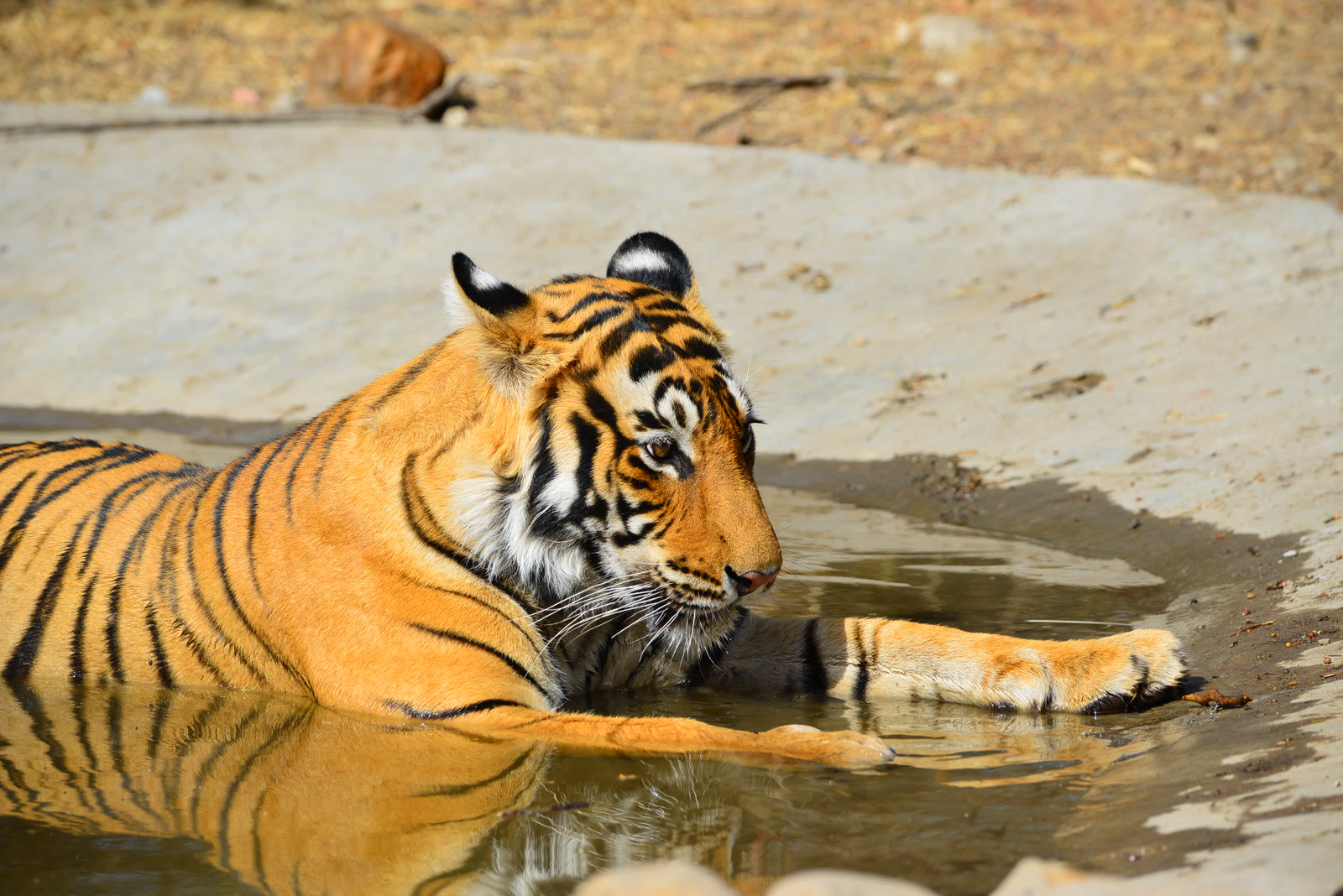
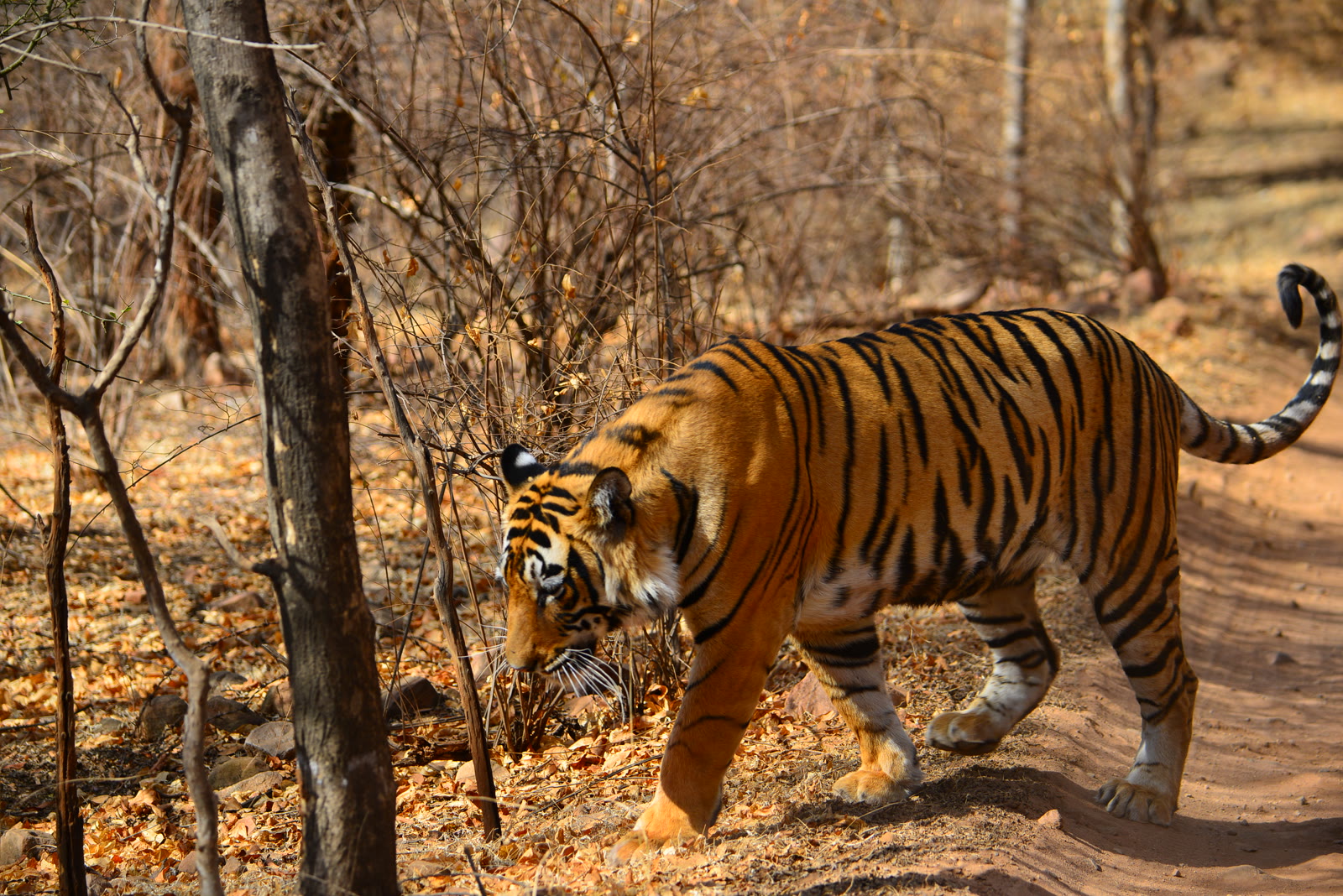
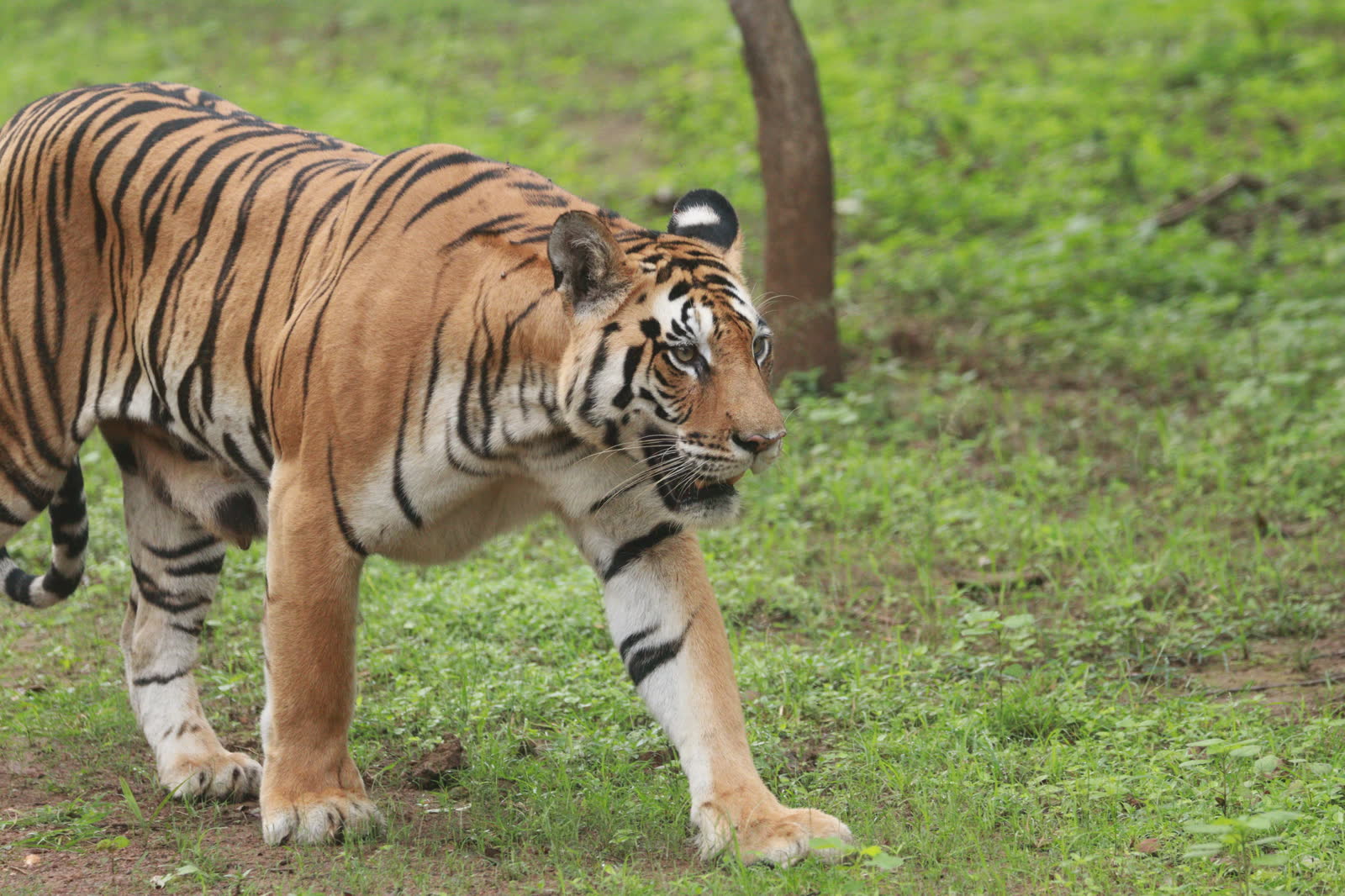
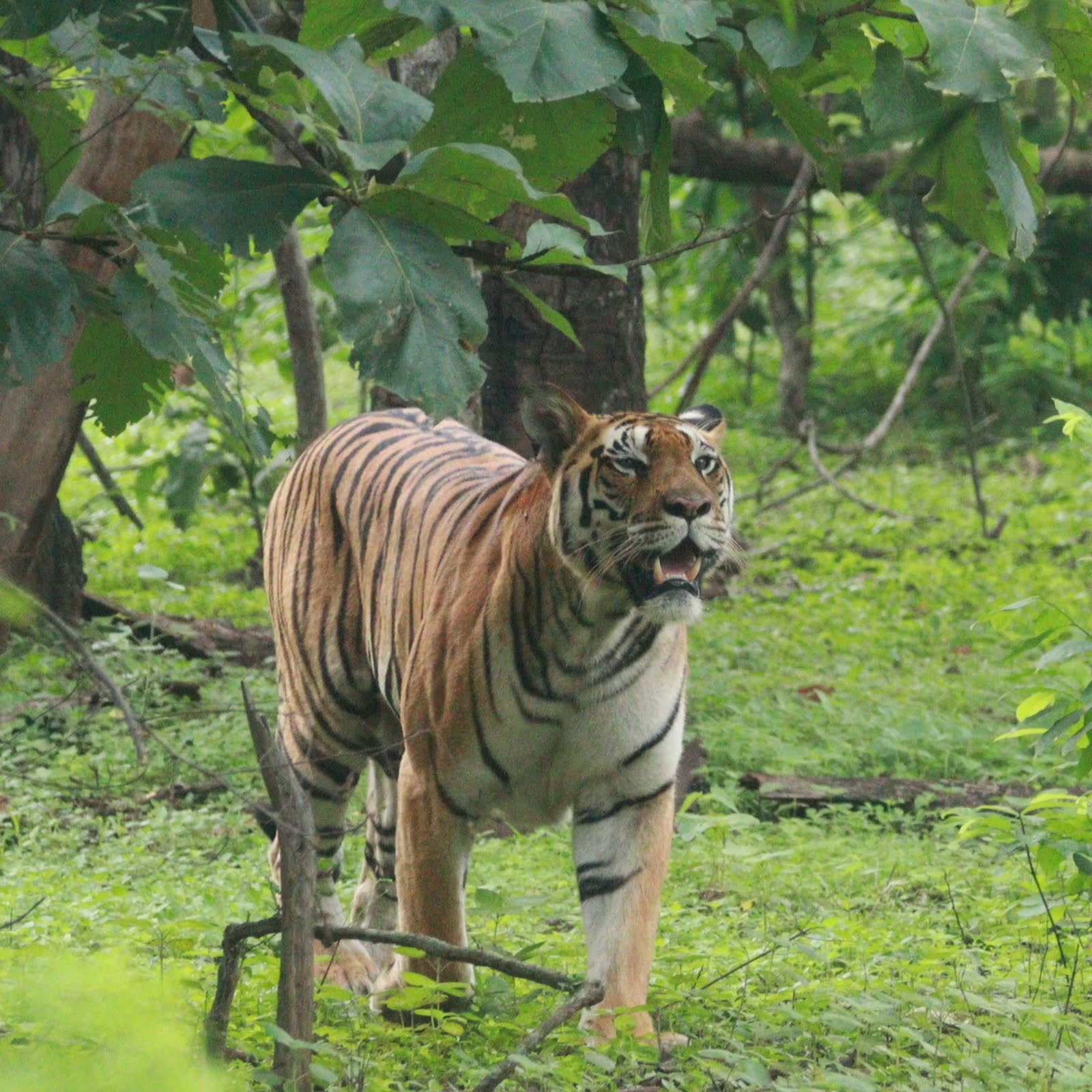
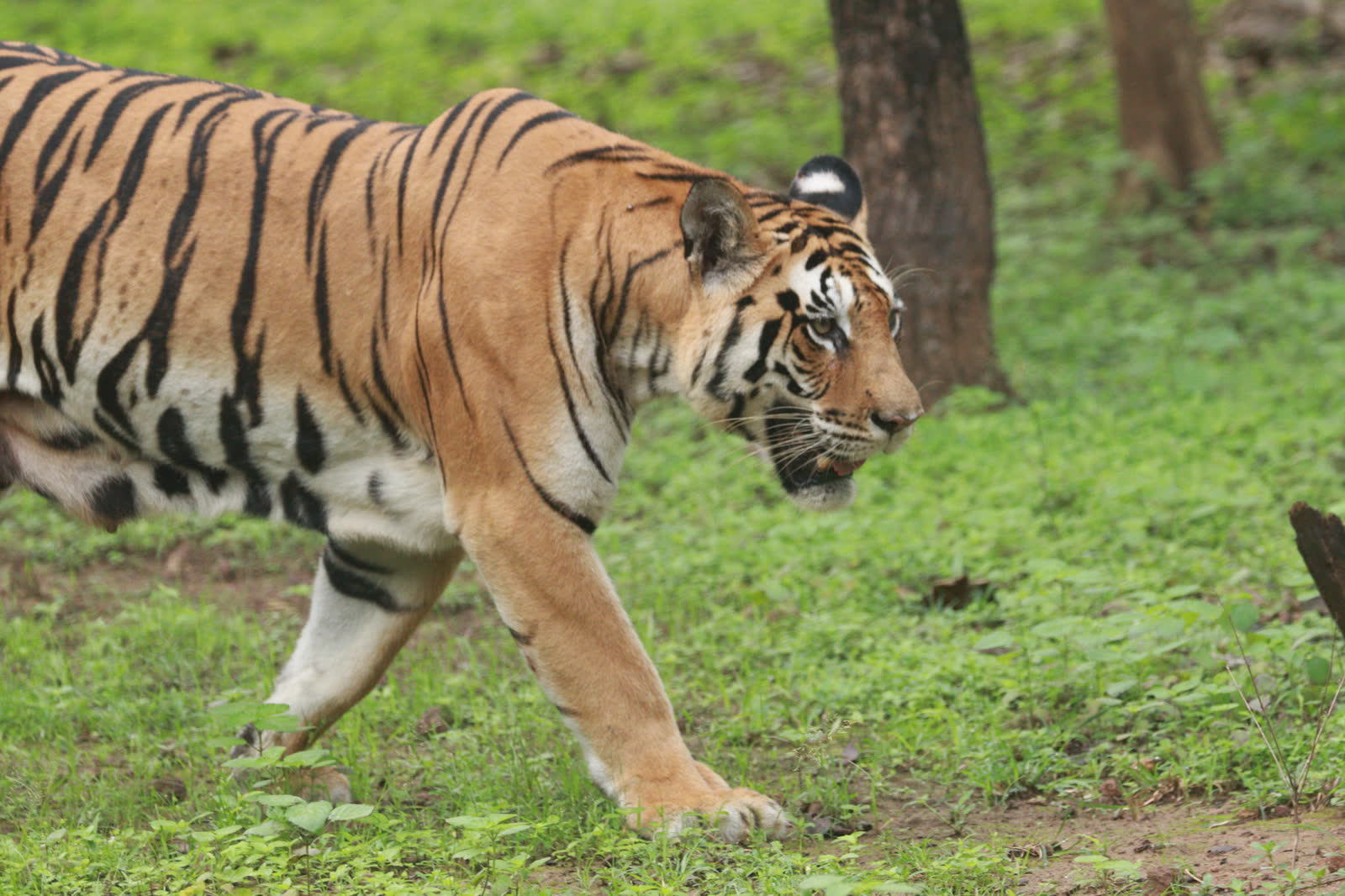
What makes the Sundarbans genuinely singular is its tiger population. This is the only place on Earth where the Royal Bengal Tiger has adapted to a mangrove, saline environment, swimming confidently between islands and hunting along muddy creek banks rather than in dry forest. Camera-trap surveys have tracked a steady, healthy population within the Indian Sundarbans in recent cycles, and the reserve's combination of UNESCO status, unbroken mangrove cover and a thriving tiger population makes it one of the great success stories of Indian conservation.
What to expect: Expect a slow, watchful journey by boat through mangrove creeks, watchtowers offering the best chance of a tiger on a mudbank or a saltwater crocodile basking below, and rich birdlife and dolphin activity throughout. Tiger sightings, while never promised, reward patience and are a genuine possibility on a well-planned multi-day itinerary.
Facts About Sundarbans National Park
| Category | Details |
|---|---|
| Location | South 24 Parganas district, West Bengal, Ganges-Brahmaputra delta |
| State | West Bengal |
| Established | Tiger Reserve 1973 · Wildlife Sanctuary 1977 · National Park 1984 · UNESCO World Heritage Site 1987 |
| Area | National Park 1,330 sq km, within a Tiger Reserve of about 2,585 sq km |
| Protected Area Type | National Park, Tiger Reserve, UNESCO World Heritage Site, Biosphere Reserve, Ramsar Wetland |
| Functional Days | Open through the year |
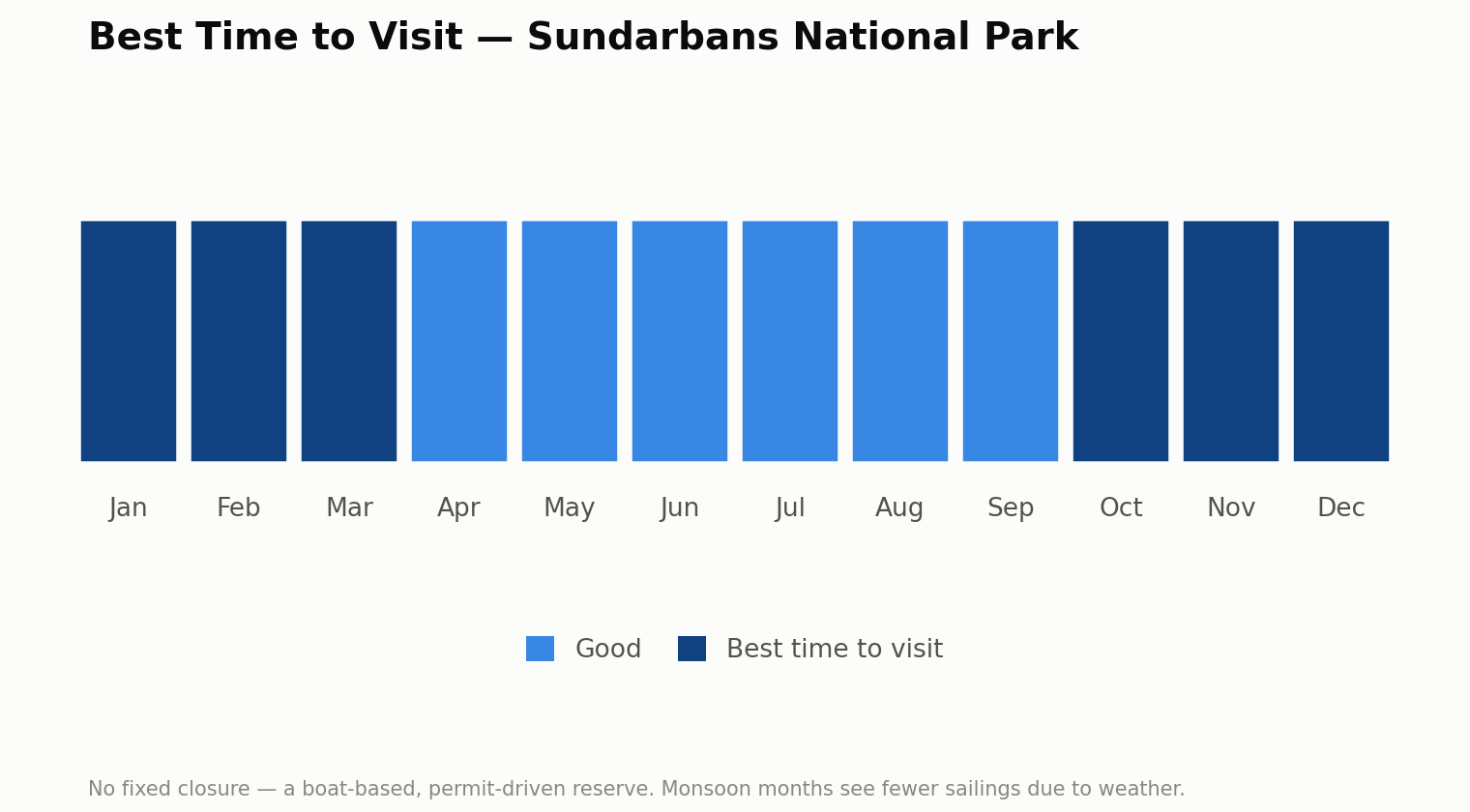
| Annual Closure | None fixed; the monsoon (June to September) sees fewer sailings |
| Weekly Offs | None |
| Best Time to Visit | October to March |
| Recommended Safari Duration | 2 to 3 days, 1 to 2 nights afloat or at a riverside lodge |
| Vegetation | Mangrove forest — Sundari, Gewa, Goran, Nypa palm |
| Elevation | Near sea level |
| Major Wildlife | Royal Bengal Tiger, saltwater crocodile, Irrawaddy dolphin, spotted deer |
| Famous For | The world's largest mangrove forest and its mangrove-adapted, swimming tigers |
Functional days. The Sundarbans is open to visitors throughout the year, with boat safaris departing daily from the reserve's river gateways during the main season.
Yearly off. There is no fixed annual closure, though the monsoon months of June to September bring heavier rain and rougher water, and most private itineraries steer visits toward the calmer months either side of it.
Weekly offs and rules. There are no weekly closures. Movement inside the reserve is strictly by permitted boat along designated channels, and landing is allowed only at watchtowers and designated jetties.
Tiger Density and Other Major Species
Unlike most of the parks in this guide, the Sundarbans is explored almost entirely by water, and its tigers are correspondingly harder to see than in a dry, driveable forest — but this is a genuine, thriving tiger reserve, not a stand-in for one. The Royal Bengal Tiger here is uniquely adapted to a saline mangrove habitat, swimming between islands and hunting along muddy creek banks, and camera-trap surveys have shown a steady, well-managed population within the Indian Sundarbans.
| Survey Year | Estimated Tigers (Indian Sundarbans) |
|---|---|
| 2014 | Around 76 |
| 2018 | Around 88 |
| 2022 | Around 100 |
The trend across recent survey cycles has been a steady rise, a genuine conservation success story for a landscape that is far harder to census than a dry forest, since tigers here move across water and dense mangrove rather than open ground. Sightings are concentrated around the watchtowers at Sudhanyakhali and Dobanki, where waterholes and clearings draw animals into view, and along the wider creek network near Sajnekhali. Tigers remain naturally elusive in this terrain, and sightings, while never guaranteed, are a real and celebrated possibility on any well-planned multi-day boat itinerary — and the wider experience of gliding through mangrove creeks, past crocodiles and dolphins, remains rewarding regardless of whether a tiger appears.
Other species
- Saltwater crocodile: India's largest reptile, frequently seen basking on mudbanks from the boat.
- Spotted deer (chital): Common on the forest edges near watchtowers.
- Wild boar: Regularly seen foraging along the creek banks.
- Rhesus macaque: Present throughout the mangrove islands.
- Fishing cat: The Sundarbans' signature small cat, elusive but present in good numbers.
- Irrawaddy and Gangetic dolphins: Both surface in the wider river channels, a highlight of many boat safaris.
- Water monitor lizard: Frequently seen along muddy banks and mangrove roots.
- Birds: White-bellied sea eagle, brown-winged and collared kingfishers, ospreys, herons and egrets of several species, and large numbers of migratory waders through the winter months.
Safari Zones in Sundarbans National Park
There are no jeep zones here; instead, a handful of permitted boat routes and watchtowers structure every visit, each reached by launch from the reserve's river gateways. Most itineraries combine two or three of these over a multi-day trip.
| Zone | Area | Character |
|---|---|---|
| Sajnekhali | Entry point | Interpretation centre, bird sanctuary and mangrove nursery |
| Sudhanyakhali | Core-adjacent | Watchtower with a waterhole, among the best for tiger sign |
| Dobanki | Core-adjacent | Elevated canopy walkway through dense mangrove |
| Netidhopani | Deeper core-adjacent | Watchtower beside forest ruins, quieter and more remote |
Sajnekhali
The main gateway into the reserve, Sajnekhali combines a small interpretation centre, a mangrove nursery and a bird sanctuary, and is usually the first stop on any boat itinerary.
Sudhanyakhali
A watchtower overlooking a freshwater waterhole that draws deer and, on good days, tigers into the open. It is widely regarded as the single best spot in the reserve for a genuine sighting.
Dobanki
An elevated canopy walkway that lets visitors move through dense mangrove above the mud, ending at a watchtower with wide views over the surrounding creeks.
Netidhopani
A quieter, more remote watchtower beside the ruins of an old temple, reached by a longer boat journey and rewarding for visitors who want fewer other boats around them.
Vehicles and rules
There are no vehicles or road access anywhere in the reserve; every stretch is reached by permitted launch along designated channels, and landing is allowed only at watchtowers and jetties. India Tiger Safari would be delighted to design your fully private Sundarbans safari: a bespoke journey through the creeks and watchtowers that suit you best, with curated stays, a private boat and a naturalist guide devoted to your party.
Mammals and Birds
The lists below are representative and not complete.
Mammals
- Royal Bengal Tiger
- spotted deer (chital)
- wild boar
- rhesus macaque
- fishing cat
- jungle cat
- Irrawaddy dolphin
- Gangetic river dolphin
- small Indian mongoose.
Birds
- White-bellied sea eagle
- osprey
- brown-winged kingfisher
- collared kingfisher
- common kingfisher
- black-capped kingfisher
- grey heron
- purple heron
- great egret
- little egret
- Indian pond heron
- lesser adjutant stork
- whimbrel
- Eurasian curlew
- common redshank
- black-tailed godwit
- gull-billed tern
- Caspian tern
- brahminy kite
- changeable hawk-eagle
- spotted dove
- greater coucal
- jungle babbler.
Accessibility
The Sundarbans is reached via Kolkata, with the final stretch of every journey completed by boat.
Train
| Station | Distance from Gateway | Notes |
|---|---|---|
| Canning | 29 km from Godkhali gateway | Nearest railhead, on the Sealdah–Canning line |
| Sealdah (Kolkata) | Around 100 km from Godkhali | Main hub for onward connections |
Air
| Airport | Distance from Gateway |
|---|---|
| Netaji Subhas Chandra Bose International (Kolkata) | Roughly 110-140 km from the river jetties |
Kolkata's airport is the only realistic air gateway, with a road transfer of two to three hours to the jetty followed by the boat journey into the reserve.
Road
Well connected from Kolkata via the Basanti Highway to Godkhali or Sonakhali (about 2.5 to 3 hours), the standard route for every private Sundarbans itinerary before transferring to boat.
Once inside the reserve, every safari is conducted by boat; there are no roads, jeep tracks or vehicle safaris anywhere in the delta.
Accommodation
Riverside camps and lodges just outside the reserve's buffer are the standard base for a Sundarbans visit.
Luxury safari lodges
A small number of well-regarded riverside camps offer air-conditioned cottages, private launches and a genuinely comfortable base for exploring the delta in comfort.
Boutique lodges and eco-lodges
Smaller eco-camps built around mangrove-facing cottages and shared launches suit travellers who want a more intimate, naturalist-led experience of the delta.
Resorts and mid-range hotels
Straightforward mid-range resorts around Gosaba and Sonakhali offer comfortable, well-located stays for shorter visits.
Budget stays
Modest guesthouses and forest rest houses near the gateway towns keep costs low for travellers prioritising more time on the water over on-shore comfort.
Choosing well
- Gate/access proximity: A lodge close to Godkhali or Sonakhali jetty minimises transfer time and maximises hours afloat.
- Dining: Properties with their own kitchens are essential, since there is little else nearby once inside the delta.
- Guiding: A lodge with its own boat and trained naturalist adds real value, given how central the boat itself is to the experience.
- Families: Multi-day boat itineraries suit older children well; very young children are better served by a shorter, single-day visit.
India Tiger Safari's bespoke private itineraries pair each creek route with a curated riverside lodge.
People Also Visit
The Sundarbans sits apart from the rest of this guide's parks, reached through Kolkata rather than the road and rail networks that connect most of India's central and northern reserves.
Singalila National Park
Also in West Bengal but a world away in character, Singalila sits in the Darjeeling hills and is reached via Bagdogra rather than Kolkata. It is a completely different corner of West Bengal — high-altitude cloud forest and red panda country rather than mangrove delta — and the two make sense only as separate trips within the state rather than a combined itinerary.
Kolkata as a gateway
For travellers building a wider eastern India itinerary, Kolkata itself, with its colonial architecture and river culture, is the natural bookend to a Sundarbans journey before or after time on the water.
Sundarbans National Park FAQs
What is the best time to visit the Sundarbans?
October to March offers the calmest water, clearest skies and most comfortable temperatures for boat-based exploration.
How many days are needed for the Sundarbans?
Two to three days with one or two nights afloat or at a riverside lodge is the minimum for a proper sense of the delta; longer itineraries reach quieter, more remote watchtowers.
Can you see tigers in the Sundarbans?
Yes, though sightings are less frequent than in a dry, driveable tiger reserve given the mangrove terrain. Watchtowers such as Sudhanyakhali offer the best chances, and sightings, while never promised, are a genuine possibility.
Which watchtower is best for wildlife in the Sundarbans?
Sudhanyakhali is generally regarded as the strongest for tiger sign, while Dobanki's canopy walkway and Sajnekhali's bird sanctuary round out a well-planned itinerary.
How do Sundarbans safari arrangements work?
India Tiger Safari handles permits, boats and naturalist guides for private guests, arranging the whole multi-day itinerary around your schedule rather than a fixed departure.
What other species can be seen in the Sundarbans besides tigers?
Saltwater crocodiles, spotted deer, Irrawaddy and Gangetic dolphins, and a wide range of waterbirds are all regularly seen from the boat.
How do you reach the Sundarbans?
Most visitors fly into Kolkata, then drive around two to three hours to a river gateway such as Godkhali or Sonakhali before transferring to a boat.
Is the Sundarbans suitable for families?
It suits families with older children well, given the multi-day boat format; a shorter single-day visit is a better fit for very young children.
What should you wear on a Sundarbans safari?
Light, breathable layers with a warm layer for early morning starts, sun protection, and closed shoes suited to boat decks and watchtower steps.
Is a private boat available in the Sundarbans?
Yes. India Tiger Safari arranges a private boat and naturalist guide as part of every bespoke Sundarbans journey.