Kaziranga National Park: Safari Guide
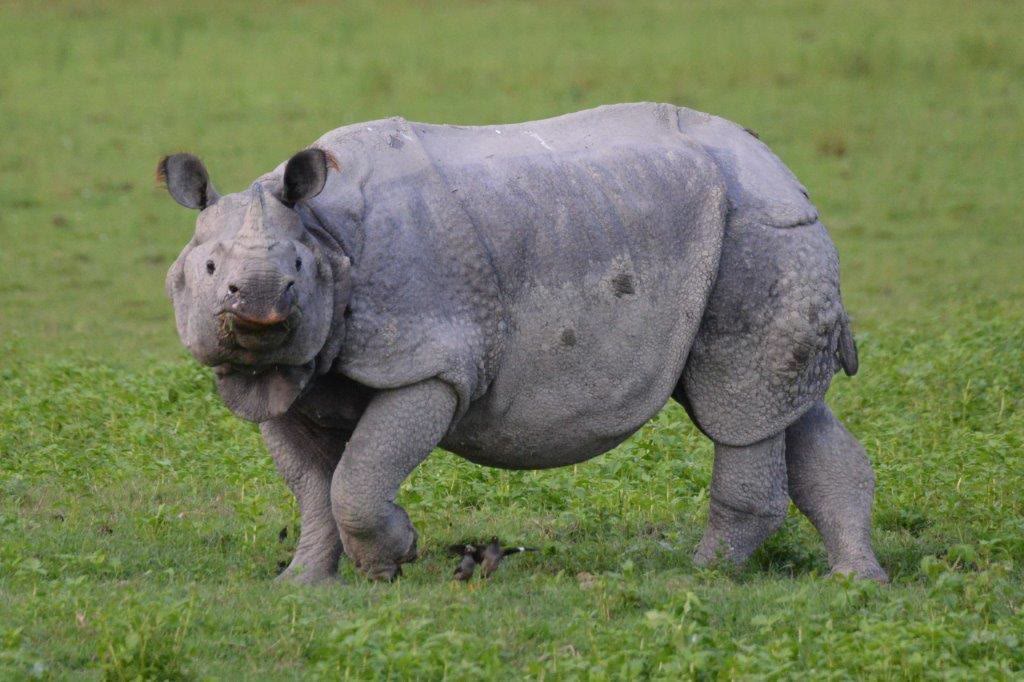
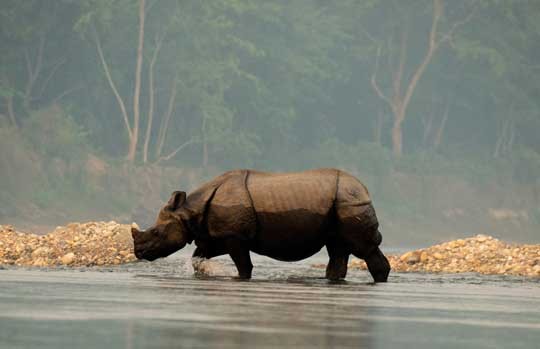
World's largest population of the Indian one-horned rhinoceros
About Kaziranga National Park
Kaziranga National Park lies along the southern bank of the Brahmaputra River in Golaghat, Nagaon, Sonitpur and Biswanath districts of Assam, in India's northeast. It sits roughly midway between Guwahati and Jorhat, on the floor of the Brahmaputra valley, where the great river's seasonal floods build and renew the grasslands that make the park famous. Kaziranga is the single most important stronghold anywhere in the world for the Indian one-horned rhinoceros, and it is this achievement, more than any other, that has shaped its identity as a global conservation landmark.
The park's protected history stretches back more than a century. The area was first set aside as a reserve forest in 1905 at the urging of Mary Curzon, who was struck by the scarcity of rhinos on a visit and persuaded her husband, Viceroy Lord Curzon, to act. It became a game sanctuary in 1916 and was renamed a wildlife sanctuary in 1950 to shed the old hunting-era terminology. Kaziranga was declared a national park in 1974, inscribed as a UNESCO World Heritage Site in 1985, and formally notified as a tiger reserve in 2007. The core national park covers about 430 km², and contiguous additions made over the following decades — including the Burapahar hills and river-formed grasslands to the east — have extended the protected landscape to roughly 880 km², with the full Kaziranga Tiger Reserve, including its buffer, spanning approximately 1,173.58 km².
Geographically, Kaziranga is defined by the Brahmaputra, which forms its northern and eastern boundary, and by the smaller Diphlu and Mora Dhansiri rivers that thread through the park itself. Each monsoon, seasonal flooding submerges large stretches of the western park for days at a time, a natural cycle that scours old vegetation, deposits fresh silt and keeps the park's famous elephant-grass meadows in a constant state of renewal.
The result is a mosaic landscape of tall grasslands, shallow ox-bow lakes known locally as beels, elevated chapories that serve as flood refuges for wildlife, and belts of tropical moist and semi-evergreen forest rising toward the Karbi Anglong hills in the south.
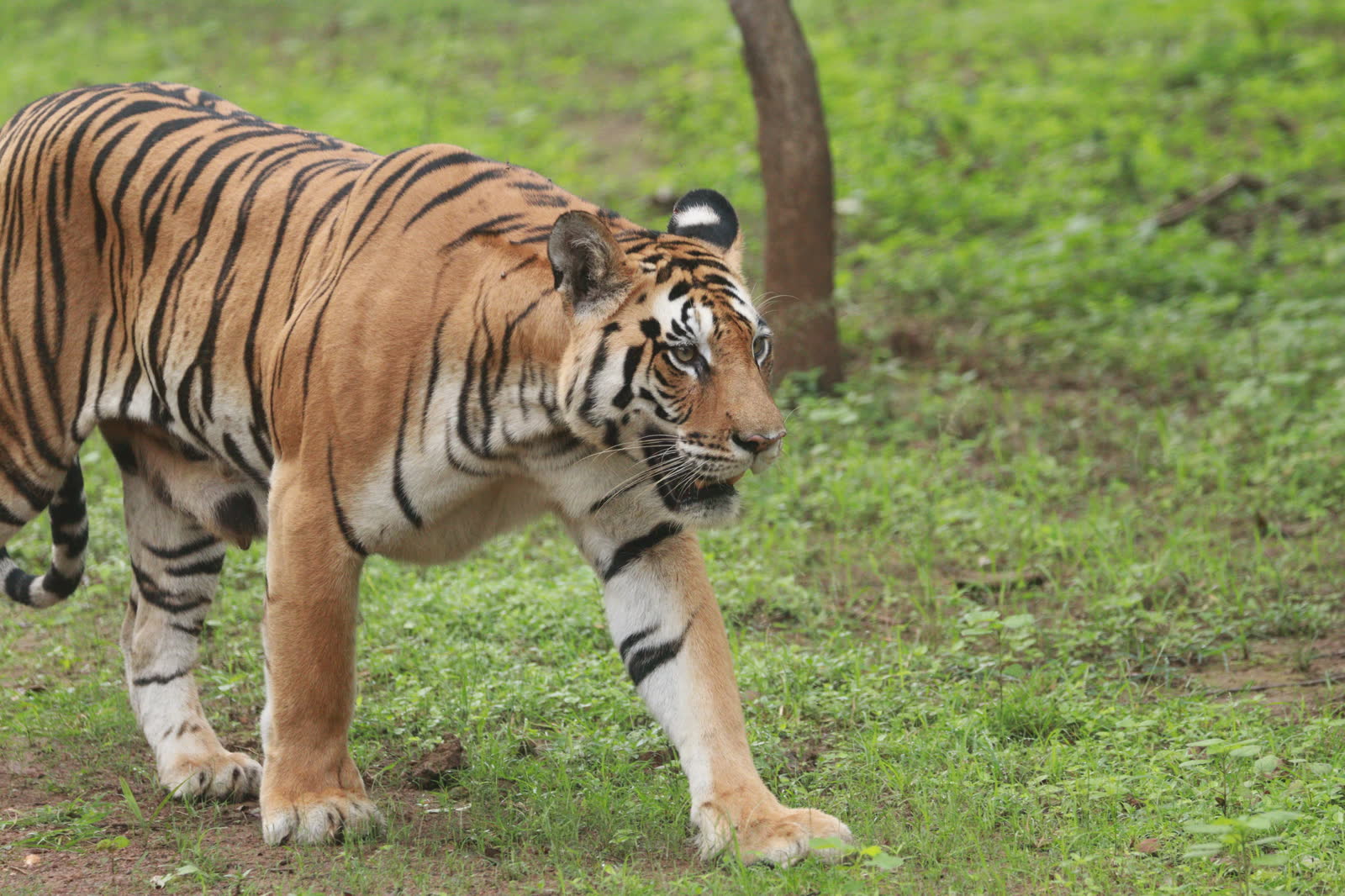
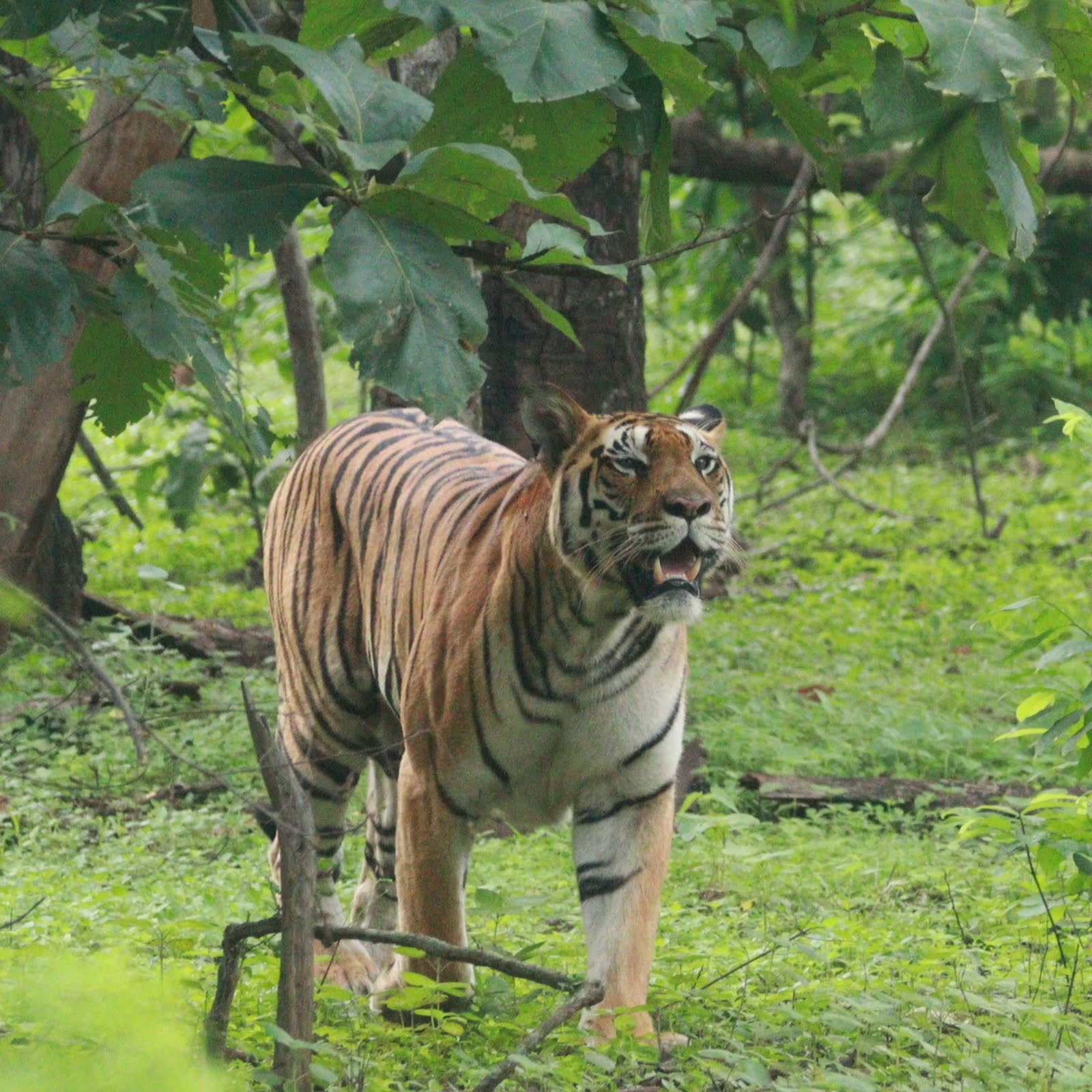
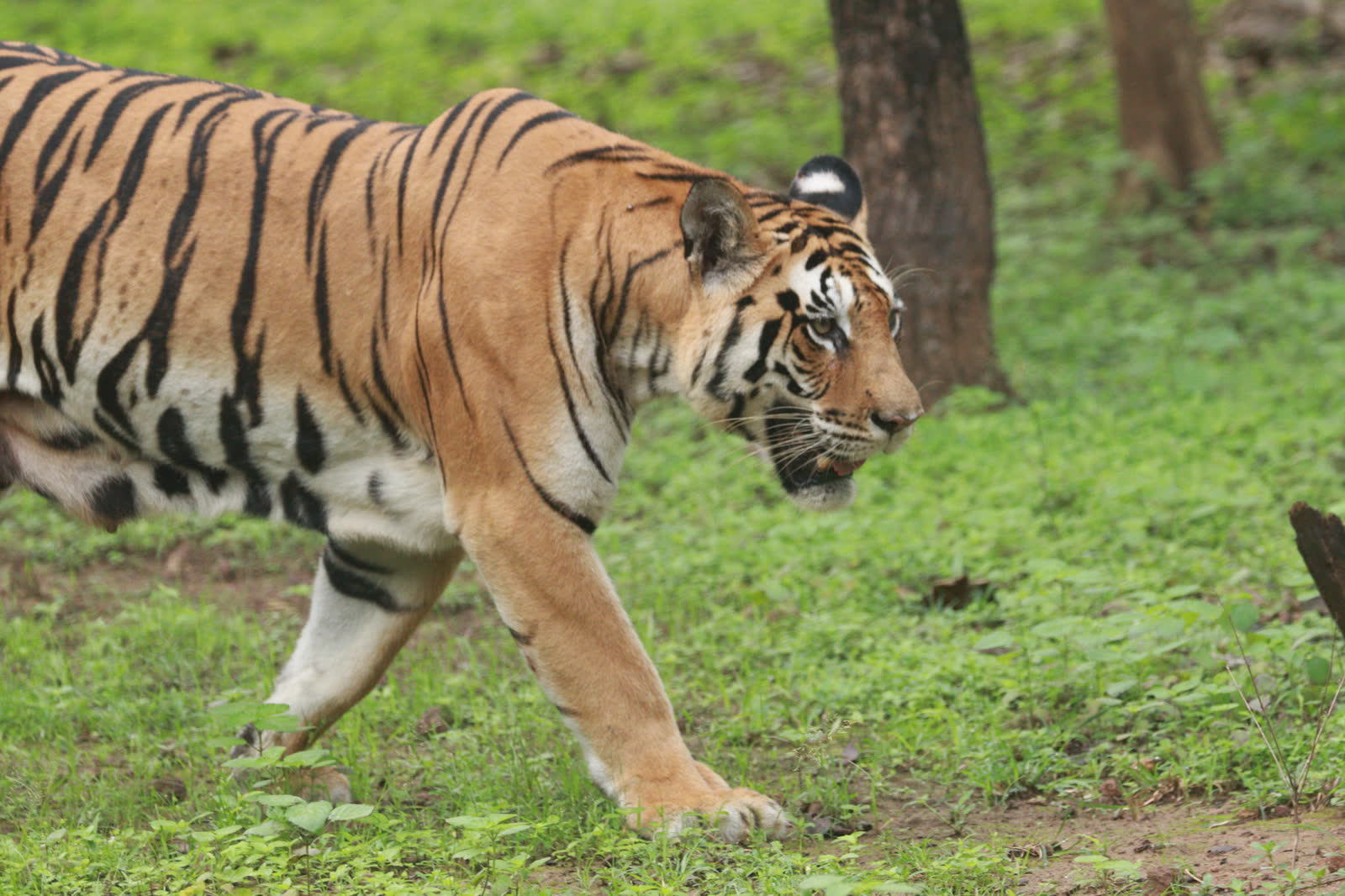
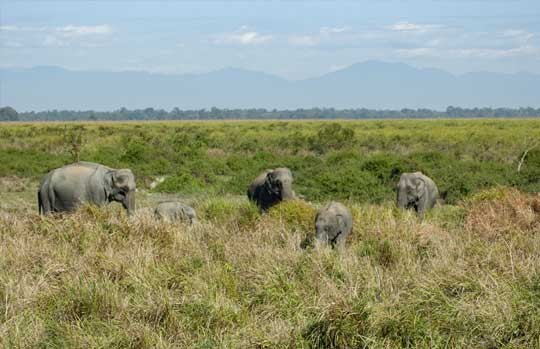
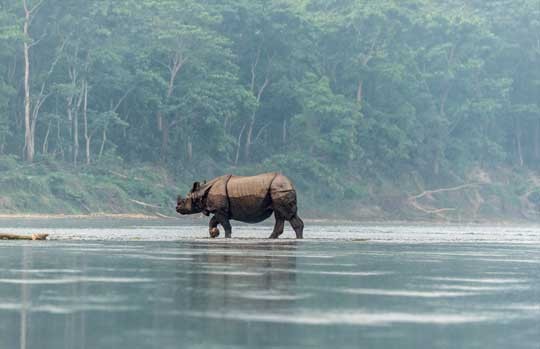
What sets Kaziranga apart is the sheer concentration and visibility of its wildlife. It holds the largest population of the Indian one-horned rhinoceros on Earth, a species that has been brought back from a precarious position through decades of dedicated protection — one of India's great conservation success stories. The park is equally significant for the Asian elephant and for the wild water buffalo, of which it holds well over half the world's population, and its open floodplain terrain makes sightings of all three unusually reliable compared with the denser forests of central India. Kaziranga's tiger population, too, has grown steadily, and camera-trap studies have recorded tiger densities among the highest anywhere in the world.
What to expect: A Kaziranga safari is built around wide-open grassland and wetland vistas rather than dense forest tracking, with jeep drives across the Central, Western, Eastern and Burapahar ranges bringing you close to grazing rhinos, elephant herds and wild buffalo against a backdrop of the Brahmaputra floodplain. Sightings of the one-horned rhinoceros, while never promised, are frequent, and the park's tiger and bird life reward guests who add an extra day or an early boat outing along the river.
Facts About Kaziranga National Park
| Field | Detail |
|---|---|
| Location | Golaghat, Nagaon, Sonitpur and Biswanath districts, Assam |
| State | Assam |
| Established | Reserve forest 1905; National Park 1974; UNESCO World Heritage Site 1985; Tiger Reserve 2007 |
| Area | Core ~430 km²; full Tiger Reserve (with buffer) ~1,173.58 km² |
| Protected Area Type | National Park, Tiger Reserve and UNESCO World Heritage Site |
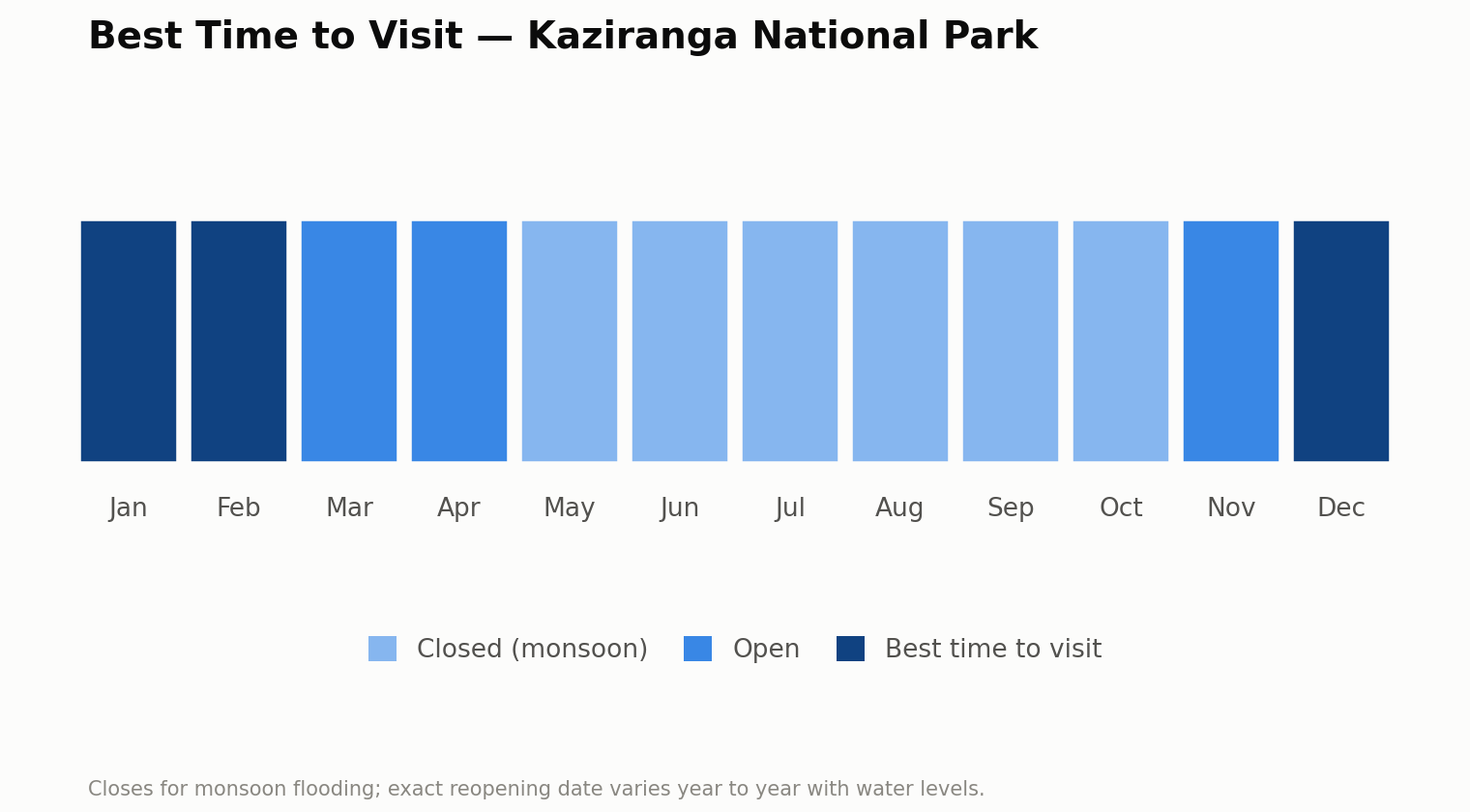
| Functional Days | Early November to mid-April (safari season) |
| Annual Closure | Mid-April to late October, for the monsoon |
| Weekly Offs | None — safaris run daily through the open season |
| Best Time to Visit | November to April, with December to February at its peak |
| Recommended Safari Duration | 3 nights, to cover multiple ranges |
| Vegetation | Alluvial grasslands, tropical semi-evergreen and moist deciduous forest, wetlands |
| Elevation | Roughly 40–80 metres, low-lying Brahmaputra floodplain |
| Major Wildlife | Indian one-horned rhinoceros, Bengal tiger, Asian elephant, wild water buffalo, eastern swamp deer |
| Famous For | World's largest population of the Indian one-horned rhinoceros |
Functional days. Jeep safaris run in two shifts a day, an early-morning drive and a mid-afternoon drive, timed around the cooler hours when animals are most active in the open grassland.
Yearly off. The park closes to tourism for the monsoon, broadly from mid-April to the last week of October, while the Brahmaputra's floodwaters replenish the grasslands and wetlands for the coming season.
Weekly offs and rules. There is no weekly closure during the open season; every range operates a permit system with a capped number of vehicles and mandatory naturalist or forest-department guides on board.
Tiger Density and Other Major Species
| Census Year | Rhino Population | Notes |
|---|---|---|
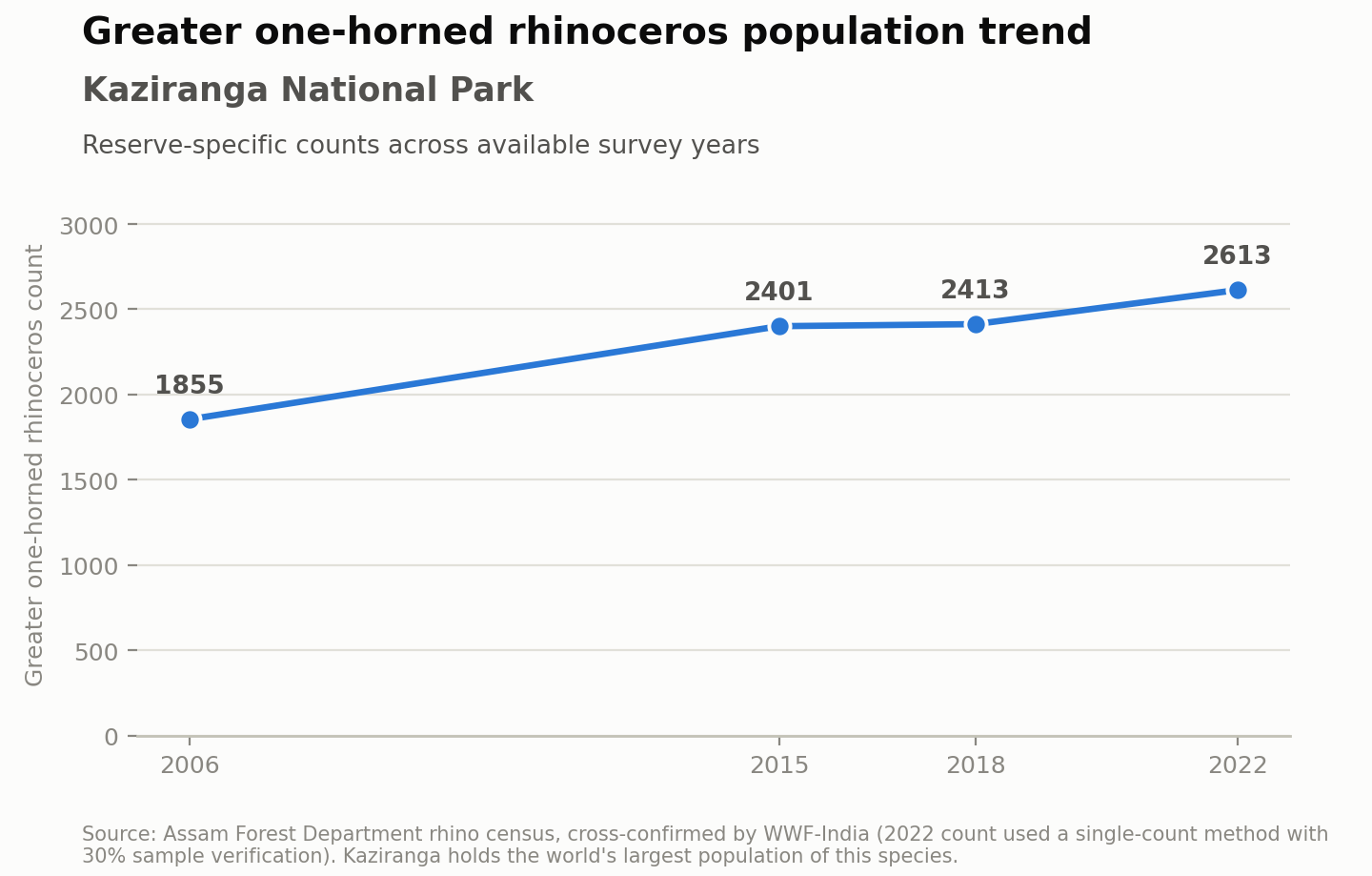
| 2015 | 2,401 | Baseline for recent recovery tracking |
| 2018 | 2,413 | Modest, steady increase |
| 2022 | 2,613 | Up roughly 200 in four years |
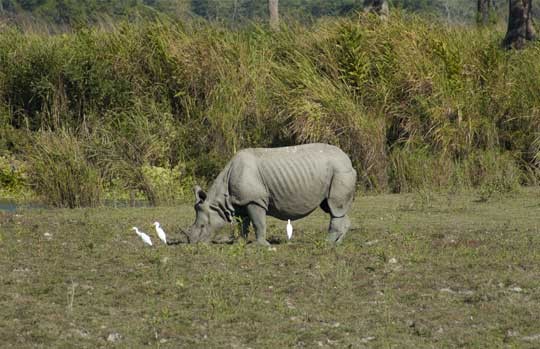
Kaziranga's rhino numbers have grown steadily across every recent census, a trajectory conservationists point to as one of the finest recovery stories in global wildlife management. Sightings are best in the open grasslands of the Central and Western ranges, where rhinos graze in full view within a short distance of the jeep track, and along the beels where they wallow through the warmer months.
Tigers share this success. Kaziranga was declared a tiger reserve in 2007, and independent camera-trap surveys have since measured tiger densities of around 32 individuals per 100 km² in parts of the park — among the highest recorded anywhere on Earth — placing Kaziranga among the world's top three reserves for tiger density. Because the terrain is tall grassland rather than dense forest, tiger sightings are less frequent than rhino or elephant sightings and are, as always, never guaranteed, though alert naturalists regularly pick up pug marks, alarm calls and the occasional daylight crossing.
Other species
- Asian elephant: Large herds move through the grasslands and forest edges year-round and are seen on most safaris.
- Wild water buffalo: Kaziranga holds well over half the world's population, commonly seen grazing near the beels.
- Eastern swamp deer: Found in good numbers across the central grasslands, often in mixed herds with hog deer.
- Hog deer and Indian muntjac: Common smaller deer species seen at forest edges and grassland margins.
- Hoolock gibbon: India's only ape, along with capped langur and golden langur, found in the forested Burapahar range.
- Sloth bear and small carnivores: Sloth bear, jungle cat, fishing cat and civets are present, though sighted less often.
- Birds: Roughly 500 species have been recorded, including the great pied hornbill, Pallas's fish eagle, black-necked stork, Bengal florican and vast winter congregations of migratory waterfowl.
Safari Zones in Kaziranga National Park
Kaziranga is managed across five ranges, four of which are regularly open to tourists, each entered on a separate permit with its own vehicle allocation.
| Zone | Character |
|---|---|
| Central (Kohora) | Classic open grassland and beels; the park's most visited range |
| Western (Bagori) | Wide floodplain with dense rhino and buffalo concentrations |
| Eastern (Agaratoli) | River-fed wetlands, strong for birdlife and boat safaris |
| Burapahar (Ghorakati) | Forested hills and streams, quieter and less crowded |
Central Range (Kohora)
The Central Range is Kaziranga's original and most iconic safari zone, built around the Mihimukh grasslands and a chain of beels that reliably hold rhino, elephant and swamp deer. Its observation towers give sweeping views across the floodplain toward the Brahmaputra, and it remains the range most visitors experience first.
Western Range (Bagori)
Bagori opens onto broad alluvial grassland close to the river, with some of the park's highest densities of rhino and wild buffalo. The range's interpretation centre and its proximity to several lodge clusters make it a popular choice for a second safari within the same visit.
Eastern Range (Agaratoli)
Agaratoli sits closest to the Brahmaputra's wetlands and is the strongest range for birdlife, including migratory waterfowl in winter and resident fish eagles year-round; a boat safari here, where operated, adds a different vantage on the park's beels and sandbars.
Burapahar Range (Ghorakati)
The westernmost range climbs into forested hills rather than open grassland, offering a quieter, more wooded safari with a better chance of hoolock gibbon and langur sightings, and noticeably fewer vehicles than the other three ranges.
Vehicles and rules
Each range issues a fixed number of jeep permits per shift, with an authorised naturalist or forest guide required on board at all times; elephant-back safaris and Brahmaputra boat outings are offered as add-ons at select ranges. India Tiger Safari would be delighted to design your fully private Kaziranga safari: a bespoke journey through the ranges that suit you best, with curated stays, a private jeep and a naturalist guide devoted to your party.
Mammals and Birds
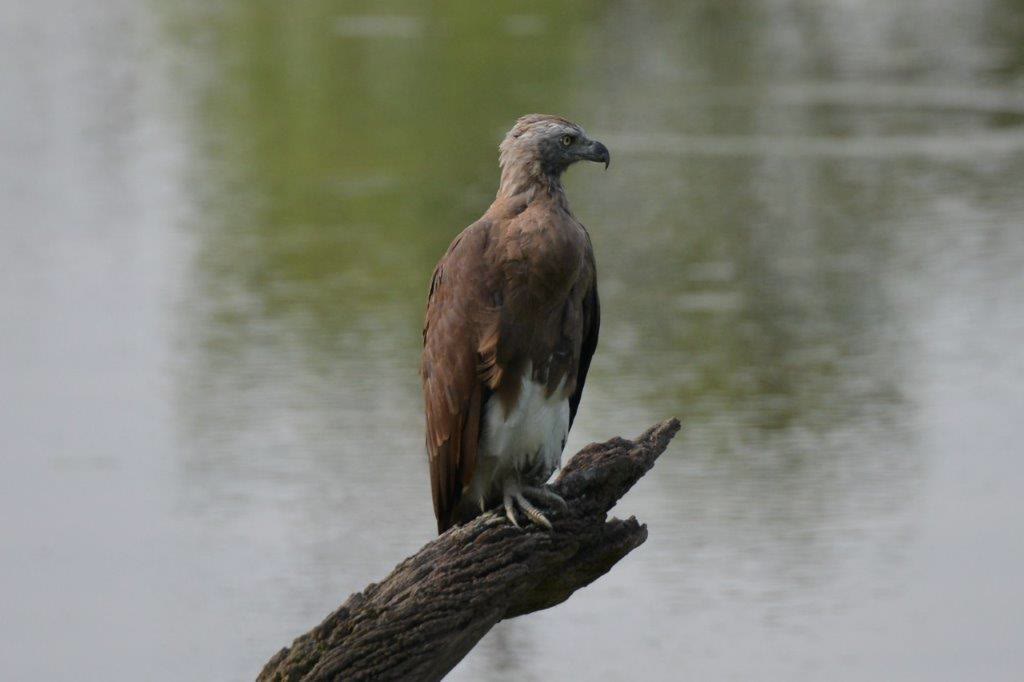
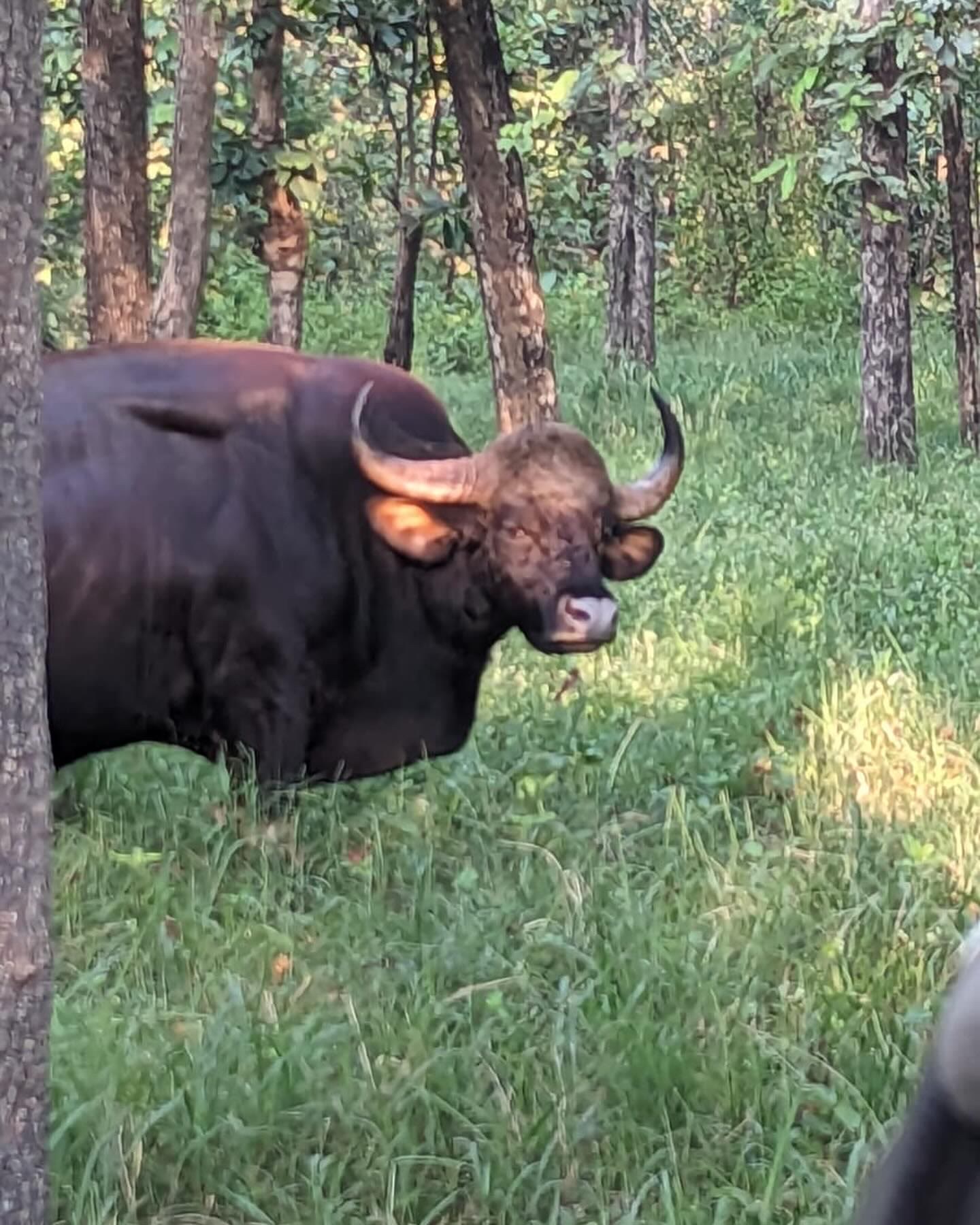
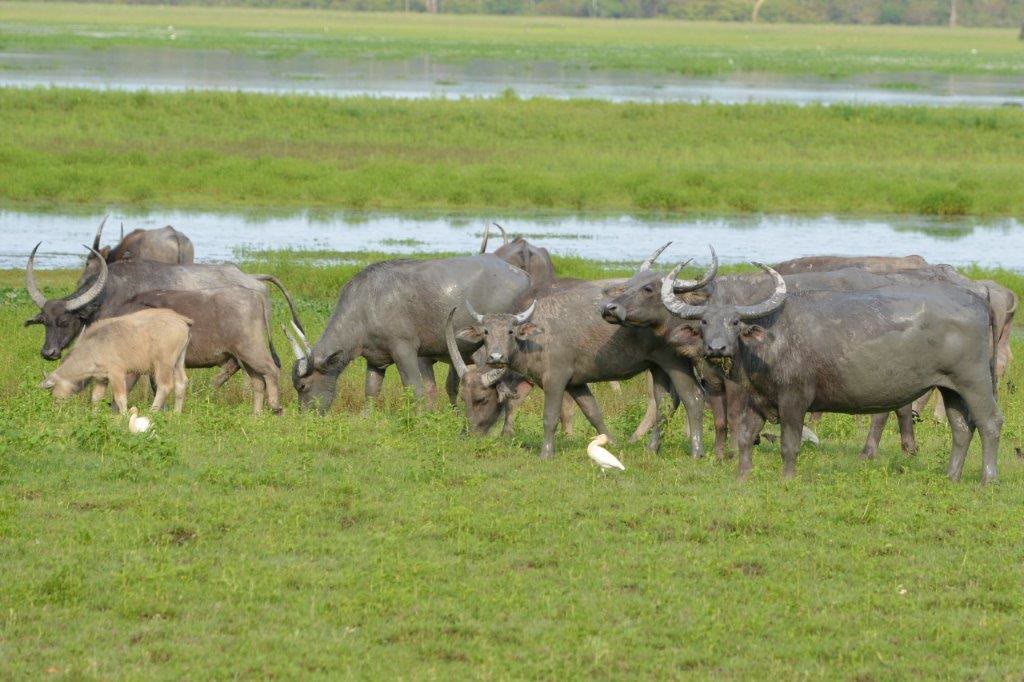
The lists below are representative and not complete.
Mammals
- Indian one-horned rhinoceros
- Bengal tiger
- Asian elephant
- wild water buffalo
- eastern swamp deer
- hog deer
- Indian muntjac
- Indian boar
- hoolock gibbon
- capped langur
- golden langur
- Assamese macaque
- sloth bear
- Indian leopard
- jungle cat
- fishing cat
- leopard cat
- golden jackal
- Bengal fox
- small Indian civet
- large Indian civet
- hispid hare
- Chinese pangolin
- Indian pangolin
- particoloured flying squirrel.
Birds
- Great pied hornbill
- wreathed hornbill
- Pallas's fish eagle
- grey-headed fish eagle
- eastern imperial eagle
- greater spotted eagle
- black-necked stork
- greater adjutant
- lesser adjutant
- Asian openbill
- swamp francolin
- Bengal florican
- pale-capped pigeon
- Finn's weaver
- baya weaver
- Jerdon's babbler
- marsh babbler
- bristled grassbird
- ferruginous duck
- lesser white-fronted goose
- spot-billed pelican
- white-rumped vulture.
Accessibility
Kaziranga is reached through Assam's well-connected northeastern transport network, with the main Kohora entrance sitting directly on National Highway 37.
Train
| Station | Distance and road time | Why use it |
|---|---|---|
| Furkating Junction | 75 km, about 1.5–2 hours | Best-connected station, with links to Guwahati, Kolkata and Delhi |
| Jorhat Town | 90 km, about 2 hours | Alternative with regional connections |
Air
| Airport | Distance and road time | Onward transport |
|---|---|---|
| Jorhat (Rowriah) Airport | 97 km, about 2–3 hours | Private transfer or taxi |
| Lokpriya Gopinath Bordoloi International Airport, Guwahati | 217 km, about 4 hours | Private transfer or taxi |
Guwahati offers the wider choice of domestic and international connections, while Jorhat cuts the road transfer roughly in half for guests short on time.
Road
Guwahati to Kaziranga: About 200 km on NH 37, roughly 4 hours by private car. Tezpur to Kaziranga: About 50 km, under 1.5 hours, a convenient link for guests combining Kaziranga with western Arunachal Pradesh. Jorhat to Kaziranga: About 90 km, around 2 hours, useful when flying into Jorhat.
Inside the park, only authorised safari vehicles are used, with a naturalist on board at all times, and boat safaris are available on the Brahmaputra at select ranges.
Accommodation
Lodges and resorts cluster around the Kohora entrance and along the highway toward Bagori, giving easy access to the Central and Western ranges in particular.
Luxury safari lodges
Riverside and boutique properties near Kohora offer private cottages, curated dining and dedicated naturalists, several set within their own tea-garden or forest-edge grounds facing the park boundary.
Resorts and mid-range hotels
A wider band of comfortable resorts lines the highway near Kohora and Bagori, offering easy access to multiple ranges within a short drive.
Budget stays
Simple guesthouses and homestays in villages near the park boundary, including community-run stays that channel income directly to local families, suit travellers prioritising value over amenities.
Choosing well
- Gate proximity: A base near Kohora or Bagori keeps early-morning transfer times short.
- Dining: Properties with their own kitchens and Assamese menus offer a more complete regional experience.
- Guiding: Confirm whether an in-house naturalist accompanies safaris, in addition to the mandatory forest guide.
- Families: Cottage-style layouts and properties with gardens suit families better than compact hotel rooms.
India Tiger Safari's bespoke private itineraries pair each range with a curated lodge.
People Also Visit
Assam and the wider northeast pair naturally with Kaziranga for travellers extending their journey into the region's other great parks.
Manas National Park
Manas lies a few hours' drive west of Kaziranga, on the Bhutan border, and offers a strikingly different experience: forested hills and the Manas River in place of open floodplain grassland, with golden langur, pygmy hog and wild buffalo alongside a fast-recovering tiger population. Many guests combine the two parks into a single Assam itinerary.
Kaziranga National Park FAQs
What is the best time to visit Kaziranga National Park?
November to April is the safari season, with December to February offering the coolest weather and the clearest grassland visibility.
How many days are needed for a Kaziranga safari?
Three nights allow guests to safari across the Central, Western and Eastern ranges without rushing between them.
Can you see the one-horned rhinoceros in Kaziranga?
Kaziranga holds the world's largest population of the species, and sightings in the Central and Western ranges are frequent, though as with all wildlife they are never guaranteed.
Which range is best for a first safari in Kaziranga?
The Central Range around Kohora is the classic introduction, with the Western Range at Bagori a strong choice for a second drive focused on rhino and buffalo.
How do Kaziranga safari arrangements work?
India Tiger Safari handles permits, vehicles and naturalist guides for its private guests, building each Kaziranga itinerary around preferred ranges, timings and pace.
What other wildlife can be seen in Kaziranga besides rhinos?
Asian elephants, wild water buffalo, swamp deer, tigers and around 500 recorded bird species, including hornbills and migratory waterfowl in winter.
How do you reach Kaziranga National Park?
Most guests fly into Guwahati or Jorhat and transfer by road; Furkating Junction is the best-connected railway station, about 75 km from the park.
Is Kaziranga suitable for families with children?
Yes — the open-grassland safaris are gentle and highly visual, making sightings easier for younger children than in denser forest parks.
What should guests wear on a Kaziranga safari?
Neutral, muted colours, layered clothing for cool mornings, a hat, sunscreen and closed shoes are recommended for open-jeep drives.
Is a private jeep available in Kaziranga?
Yes — India Tiger Safari arranges a private vehicle, or boat where relevant, and a dedicated naturalist guide as part of its bespoke Kaziranga journeys.